Tag Archive | "cortex"

ARM Products and Platforms Primer and Resource List for Mobile Internet Devices in 2010. (Updated)

Tags: , , , , , , , , ,


Updated: 14th Jan 2010

Updated: 18th Jan 2010 (added ARM slide)

Updated: 28 Jan 2010 (added possible Apple licensee (for A4 processor) information.

The ecosystem around ARM, its designs and licensee products can be difficult to understand so I’ve been researching the current status and have summarized the important products, brands and technologies in the article below. You’ll find details on all the important keywords and technologies, links to all the important CPUs and platforms, a reading list and some ‘tip’s’ for CES2010 which starts this week. All the information is based on my own knowledge and research so if you spot any errors, please be sure to let us all know in the comments. I know there are some CPU designers and ARM partners reading this site so again, if there’s anything that needs changing or adding, please help us all by adding a comment below.
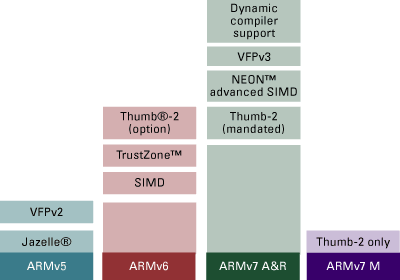
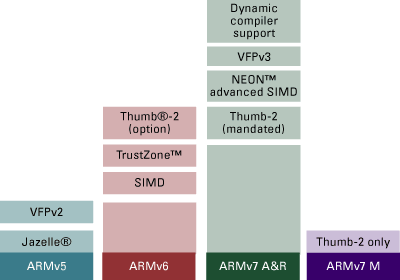
armarch

Overview of processor architectures in current ARM products

For the purposes of this article I’m ignoring anything other than ARM v7 architecture CPUs. In my opinion and experience the previous (ARMv6, ARMv5) designs don’t provide the processing power needed for the quality web experience expected in  MIDs. Note: Tegra (current version 2009) is an ARM11 multi-core CPU  implementation based on ARMv6 architecture. I expect Nvidia to move to ARMv7 in their next Tegra product.

ARM v7 is a CPU architecture, not a CPU.

ARM V7 is a processor architecture. It’s a design that belongs to ARM and it can be used to build CPUs that can process around 2 Dhrystone MIPS/Mhz. (Wikipedia – Dhrystone) That’s about 2000 DMIPs/Ghz which is not far from the processing power achieved by simple, non-hyperthreading Intel Atom cores also used in MIDs. DMIPs processor performance is not the only measurement of device speed but it’s a good starting point and is relevant to web rendering and web applications.

Processing power

In general, the architecture is being used to make CPUs and platforms running at between 600-1000Mhz (about 1200-2000 DMIPs) although there is one known implementation that has been tested at over 2Ghz. Power consumption per core is said to be around 300mw per 2000DMIPs using the latest manufacturing processes although this figure can vary greatly depending on implementation.

Remember that the CPU core takes only a small percentage of the power drain in a working device where the total in-use power budget including screen lighting, radios, audio, gpu, storage and DC components can span from 2W to 10W. (Texas instruments thinks that a 1W MID is possible though)

In comparison with the Intel Atom CPU the ARM v7 architecture can be used to make CPUs that consume about 1/3 – 1/5th of the power of an Intel Atom CPU for the same DMIPs computing power.

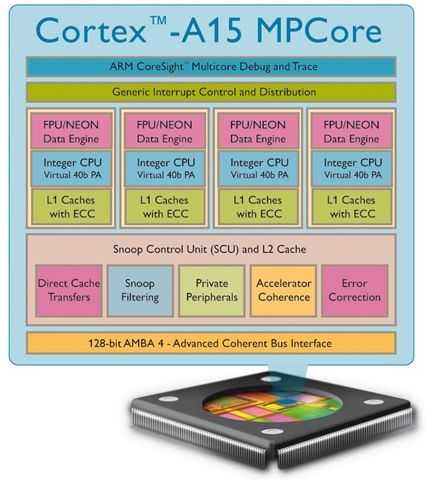
ARMv7 can also be used to make multi-core CPUs where up to 4 cores can be used to provide over 8000 DMIPS of computing power. (Assuming the software is built to handle multi-processing hardware)

(Further note: All these figures based on research, marketing figures, experience, testing and technical documents that I have read during this research.)

ARM does not manufacture CPUs.

The architecture created by ARM is used to do two things:

  • The architecture is used by ARM themselves to make a complete processor implementation which may include other ARM property. The CPU implementation is then licensed out to third parties who can either mass produce the CPU or build and manufacture complete computing platforms including graphics, sound, power, memory, etc. One example is the Ti OMAP 3 and 4-series platforms.
  • The architecture gets licensed out to third parties who make their own processors and platforms based on it. One example is the Qualcomm Snapdragon platform.

ARM have a number of processors that they’ve built using ARMv7 architecture and all fall under the ‘Cortex’ brand. There are real-time and highly embedded versions but the ‘A’ versions are the ones that interesting for general mobile computing tasks. ARM have three versions of the CPU. The A8 (currently in products), A9 (high end, multi-core capable due in products in 2010) and A5 (small, low-cost, due in products in late 2010) versions

Licensees.

When final products are completed by licensees you will often see them marketed under different brands. This is where it gets very confusing so I’ve listed most of the main players below along with notes and links to their various products and brands. Note that some ARM licensees are not made public and therefore no information is available.

ARM Cortex A8

ARM has 9 licencees. 8 are public.

Cortex A8 Product brief (PDF)

Licensee notes.

  • Ti OMAP 3 platforms 34xx 35xx 36xx  using Cortex A8 CPU core up to 800Mhz. Used in Nokia N900, Archos 5 devices for example.
  • Freescale iMX5 family of CPUs based on Cortex A8. Use in the Sharp Netwalker for example. iMX515 is focused at mobile internet and includes graphics co-processing.
  • Samsung. S5PC100 application processor includes the Cortex A8 CPU core (E.g. Odroid)
  • Samsung / Intrinsity – Hummingbird A very specific implementation of the Cortex Core using a tightly defined manufacturing process.
  • Zii Labs ZMS08 Core of the ‘stem cell’ computing platform. (Q1 2010 volume shipment) 1Ghz implementation.
  • Matsushita (Panasonic) Details unknown.
  • PMC-Sierra (storage, switching, routing solutions) Details unknown.

Cortex A9 (Multi-core capable)

Cortex A9 Product information (PDF)

ARM has 9 licencees. 6 are public.

Licensee notes.

  • Ti OMAP Dual-core 44xx platform. Full production expected 2H 2010.
  • ST Electronics Cortex A8 licensee (set top boxes)
  • St Ericsson – U8500 Dual Cortex A9/HSPA Modem platform. (Note Nokia and Symbian will be using this and it includes a Mali GPU and 1080p recording capability)
  • Broadcom (ARM news. No products announced yet.)
  • Nvidia Tegra 2 Dual-core
  • NEC Electronics. No information available.
  • Update: 28 Jan 2010. It appears that Apple may have licensed Cortex A9 for the iPad A4 CPU. (Source)

Cortex A9 MPCore Hard Macro – 2Ghz implementation of Cortex A9 using specific TSMC silicon manufacturing process.

Cortex A5

Cortex A5 is a multi-core, low cost ARM V7 implementation previously known as Sparrow.

Link to ARM information

No known implementations at present.

Other ARM v7 implementations:

  • Qualcomm Snapdragon platform (QSD8×50) uses single core CPU (Scorpion) based on ARMv7 architecture.
  • Qualcomm QSD8672 dual core platform at up to 1.5Ghz.
  • Marvell Armada 500 / 510 platform (PDF product brief) Up to 1.2Ghz

Notes for CES 2010 (UPDATED)

Key platform announcements to watch out for at CES 2010. Expect demonstrator products planned for 2H 2010. (All Cortex A9)

  • Nvidia Tegra 2 – Announced.
  • Ti OMAP 44xx – No news.
  • St Ericsson U8500 – Demonstrated by Movial on a set top box.

Expected in MIDs and smartbooks shipping in 1H 2010 on the following platforms. (Single core ARmv7 and Cortex A8 implementations.)

  • Freescale iMX5
  • Ti OMAP 3
  • Qualcomm Snapdragon
  • Nvidia Tegra
  • Zii Labs ZMS08

Product rumors / expectations: CES 2010.

Further reading:

Update: ARM presentation at CES.

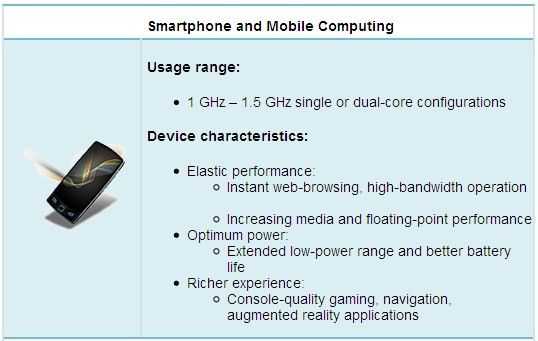
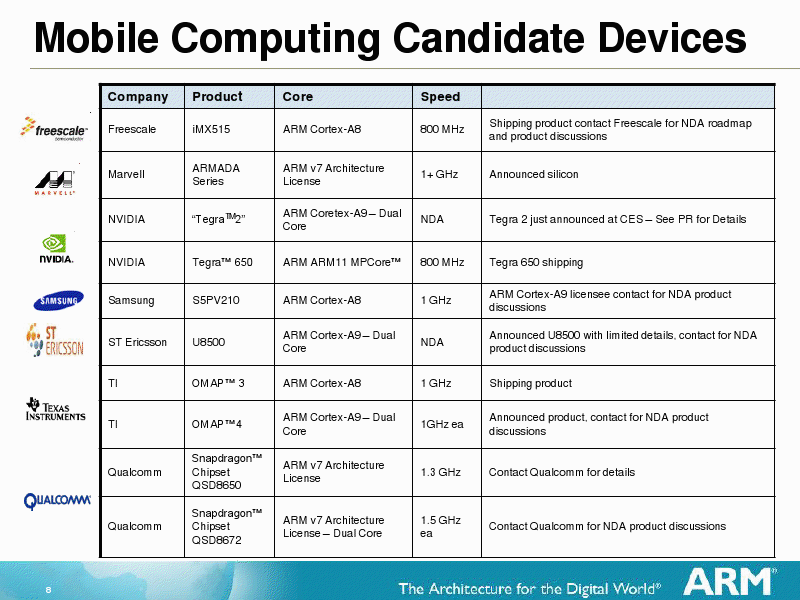
I had a chat with ARM at CES and they followed up by sending me a PDF. Here’s one slide from that PDF that is directly relevant here. It lists ‘candidate’ platforms for Mobile Computing. We listed all of these platforms above but it’s good to know what ARM sees at potential platforms.
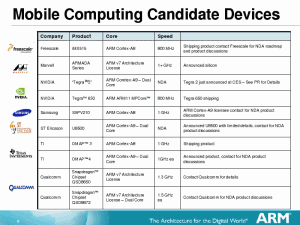
Click to Enlarge.

Note to PR agencies for ARM ecosystem partners. Put one twitter/web address in the comments and we’ll add it to the further reading list.

If you find the information useful for your work, please consider a small donation to help us continue the work. UMPCPortal is independent and funded purely through donations and advertising revenue.  Many thanks

6 WVGA Smartphones that Push The Mobile Web Envelope.

Tags: , , , , , , , , , , ,


Finally, after years of waiting and wishing, I can finally say that there are smartphones on the market that offer fast, high quality internet experiences and offer the web-focused user a converged product on which they can do tasks that, until now, required a true mobile computer. In this article I take a look at 6 of the best.

6midphones

Read the full story

Live session. Archos and Sharp. Today at 2100 CEST.

Tags: , , , , , , ,


arm-mids-live

Update: Thanks to the 800+ viewers we had on the live session. It’s great to have so much feedback on a live session. Video recordings are always available here.

On Friday evening at 1900 GMT (check your timezone here) JKK and I will be LIVE again.

For the first time ever it’s an ARM-only show featuring Cortex CPUs from Freescale and Texas Instruments. The Sharp Netwalker will be there and, if Mr DHL does his job, the Archos Internet Tablet (Android version) too.

We’ll be focusing on the Mobile Internet experience as usual but we’ll be giving a hardware overview, software overview (as much as we can given that these devices are brand new on the market) and trying to answer your questions.

The Sharp Netwalker is kindly provided to JKKmobile by Conics.net. The Archos Android Internet Tablet is kindly provided by you readers. (Please keep supporting our advertisers!) The session is unsponsored so bring beer and expect a no-holds-barred session.

Start time 1900 GMT. (Time in your location)

Live chat, audio and video

provided in the LIVE! page.

Bring your own food.

*1 About 50% chance right now on the Archos tablet. 1545 Tablet has just been delivered.

Session will be recorded.

Archos tablet information
Sharp Netwalker Information

Sharp’s 5-inch NetWalker MID Arrives. Ticking the Carrypad Boxes!

Tags: , , , , , , ,


Engadget have just posted an article on this rather interesting MID / Carrypad-like device that should challenge the UMID that Ben is currently testing. The Sharp Netwalker PCZ1

Sharp PCZ1 ARM-based smartbook running Ubuntu

Sharp PCZ1 ARM-based smartbook running Ubuntu

This isn’t an Intel-based MID device but with the Cortex-based CPU and desktop OS it should be of interest to the same target audience. I’m analysing the details right now but so far it’s looking good. Check out the gallery and the information at Engadget while I get the details together for the database. Update: It’s in the database now.
800MHz Freescale i.MX515 CPU built around the ARM Cortex-A8 architecture, 512MB of memory, 4GB of on-board flash storage (with microSDHC expansion for another 16GB), 802.11b/g WiFi, 2x USB, and QWERTY keyboard going 68 percent of full-size. Sorry, no 3G data. The PC-Z1 features a 3-second quick launch, non-removable 10-hour battery

Sharp’s 5-inch PC-Z1 NetWalker honors Zaurus legacy with touchscreen Ubuntu.

Update: More images over at Nebooked

N900 Outed in Proto Expose.

Tags: , , , , , , ,


Amazing. The Mobile-Review team out in Russia have had a prototype N900 for a while and because of the leaked information they have seen on it they have chosen to air some initial thoughts including device images and a ton of images about the OS. There’s a lot to analyse here. It’s a phone. It’s running Maemo 5. It’s looking like Nokia really is moving to Maemo as their high-end OS. I’m quite stunned that Maemo has come this far. Hats off to Nokia. I’m going to try and get myself down to Stuttgart for Nokia World now because clearly this is going to be on the agenda there in just a few weeks.

N900-clean

We’ve added all the specifications we could confirm from the article into a new N900 information page which we’ll be updating as new information comes in but for now, the best information is over at Mobile-Review.

As usual there’s a lively conversation over at Internet Tablet Talk. Your immediate thoughts are welcome in the comments below.

Omnia HD. MID, Smartphone and The End Of The Tweener.

Tags: , , , , , , ,


The Omnia HD is something that all MID fans should be taking a close look at. It highlights how close the ARM-based platforms are to Intel’s MID platforms. In fact, in many ways, the Omnia HD looks like one of the best MIDs so far with longer battery life, smaller form factor, 720p video recording and a mobile-focused software suite that addresses new mobile markets. It’s an incredibly converged product but at the same time, you could call it a tweener. Neither a 24/7 phone or high quality mobile internet device.  I intend to re-visit the Omnia HD by testing it in full in the near future but in the meantime, take a look at the specifications when placed side-by-side with the most popular tablet MID of the day and lets think about how the Omnia HD highlights that there is no such thing as a tweener.

S5D samsung-omnia-hd-3
Omnia Image via AreaMobile.

Viliv S5. (Estimated 800 Euros with 3G) Omnia HD 600 Euros Comments
CPU Intel Atom 1.3Ghz (Menlow platform) ARM (Cortex A8) 800Mhz (OMAP platform) Atom estimated 2x processing power.
Wifi BT 3G (data only) Wifi BT 3G (voice and data, HSUPA) Voice convergence is important for some. HSUPA important for Europe.
1024×600 4.8” screen (250dpi) LED, resistive touch. 640×360 3.7” screen (approx 180dpi) O-LED, capacative touch, O-LED will give outdoor readability issues. 640×360 restrictive for web browsing.
GPS (no software) GPS plus Navteq maps and social networking. GPS software for XP is expensive.
5hrs online Est, 3hrs online (based on hsdpa talk-time) For online use, the Viliv wins but the Omnia is more efficient.
10hrs standby (on, screen of) 600hrs standby (on, screen off) Always-on is important for comms!
Windows XP plus touch UI Symbian S60  plus mobile software suite (TouchWiz) S60 is mobile-focused (some exciting next-gen social and LBS apps available) but no desktop app compatability.
No cam 8mp cam with 720p recording 720p recording is a huge bonus for the consumer.
400gm 125 gm 1/3rd the weight means you can carry an extra two batteries
Video playback – 720p flexible support, 6hrs Video playback – 720p, 4.5hrs Similar video capability. XP comes with only WMV support out of box.
Storage 60GB Storage 16GB + Micro SD Big storage on the Viliv compared to Omnia.
Browsing: Desktop quality, sub 10-second average, full flash and plugins Browsing: Limited quality. Estimated 20s page load time. Omnia browsing will fall way short of a desktop experience.
3D graphics: Power VR SGX 3G Graphics: Power VR  SGX Snap!
Accelerometer Good for navi, web, ereading
FM Radio A useful, very low power information source. (Local Traffic, news, music, events)
Component, S-video out, VGA HDMI Out Digital output on Omnia turns it into a better set top box.
Best USB device support Limited USB device support If you have USB devices, they are likely to work better with the Viliv S5
Full desktop software capability Mobile-focused software capability Viliv S5 allows you to carry on using your desktop software. Desktop software is, however, expensive.
Availability: Limited roll-out Availability: Global Omnia HD will be widely available
Brand unknown outside Korea Top-tier global branding. Provides consumer confidence.

Clearly the Samsung Omnia HD has specifications that are very close to one of the best Intel-based MIDs on the market. You’re looking at an extremely capable hardware platform that provides consumer-focused MID, PMP, PVR and PND-like capabilities in a 24/7 voice-capable form factor.  It’s also got mature, consumer-friendly mobile-focused software that tackles new mobile usage scnearios and it’s reached the market before anyone else could with Intel-based MIDs that are targeted at the same usage scenarios.  For some it’s going to be seen as the ultimate converged device and one of the best ‘MIDs’ on the market.

Look at it from another angle though and you see a different story.  If you want a 24/7 phone,  the Omnia HD is very very expensive and for most people, too big.  If you’re looking for the best quality mobile web browser, PND, PMP or microblogging device, it falls short on either screen size, keyboard or software. As with most converged devices, it takes new, exciting usage scenarios and lever’s them into compromised form factors.

What I see with the Samsung Omnia HD is a device that underscores exactly the emerging  scenarios that MIDs are targeted at. It’s providing a taster of things to come.  If these scenarios develop, the new ecosystems created could support dedicated devices that fit in the space between the smartphone and the netbook. With technology like the Texas Instruments OMAP 3 platform and Intel’s Moorestown available to OEMs, it will only be a matter of tweaking the design, the software and applying the right marketing to slot the variants into the new ecosystems.

How about dropping the Omni HD’s internals into a Nokia N810-like form factor and increasing the screen to 4.8” with 250 DPI to improve the focus on mobile geo-enabled social networking? How about adding a powerful photo flash and video editing software to enhance mobile photo capabilities and add how about adding a daylight-readable 6″ screen for a move into the ebook market? Think about an iPod Plus, a Kindle with a fast browser and think about the next Nokia Tablet. A Techcrunch Crunchpad or  a Google Lattitude Social  Tablet.  A Canon/YouTube device  or even a dedicated Vodafone/BBC iPlayer.  I don’t propose that all of these are winning business opportunities but I bet there are a few opportunitues in that list for dedicated devices that people have called ‘tweeners’ in the past.

The real story here is three-fold. The Omnia HD highlights how advanced and flexible the latest smartphone platforms are.  It highlights that new usage models are emerging and that if these ecosystems grow, there will be opportunities for dedicated devices. Thank-you Samsung for highlighting that the MID concept is on the right track and that the end of the Tweener-era is nigh.

Does anyone know what CPU is in the Samsung Mondi?

Tags: , , , ,


Turning the tables on you this morning, I’m trying to find out what CPU/chipset Samsung are using in the Mondi. I’ve spent a lot of time searching but it seems that no-one at CTIA, so far, has popped the obvious question – “Hi Samsung. Is it correct that the Mondi is running an ARMv7 (E.g. Cortex) CPU and not the ARMv6 (E.g. ARM11) core that’s too under-powered for Internet browsing?” If Samsung won’t say, just dive into the settings, please someone.

At the moment, all I can find is something that Qualcom leaked last year. At WITA, they said that Samsung would be producing a MID that would be based on ARM v7. I covered it in this article and I really hope it’s true because ‘10 times the processing power of a Nokia N810’ would put this in a very special place on my wishlist.

There are a couple of new videos of the Mondi on YouTube this morning. I’ve linked them in at the bottom of the product page.

Texas Instruments enhances OMAP 3 platform for 2010 Mobile Devices

Tags: , , ,


multimediagirl While it’s very exciting to be thinking about OMAP 4 and Sparrow, they are a long, long way away from being a reality in a device. More interesting today are the Cortex A8-based products. Texas Instruments have the OMAP3 platform which includes a Cortex A8 core and you can find it in a number of leading-edge computing products like Open Pandora, the BeagleBoard and, when it launches, the Palm Pre. As these and other OMAP34xx devices reach the market, Ti will be feeding in a new range of OMAP3 platforms known as the OMAP36xx series. The platform doesn’t change much in terms of building blocks but there are important incremental improvements all round. The platforms will be available for sampling in Q3 2009 which probably means 2010 production and products.

Most important are the improvements brought by moving to a 45nm process (as the Intel Atom uses) which are said to improve efficiency by up to 25%.  An extra 30 minutes mobile browsing time here and there is never a bad thing! Key features reported on the press release are shown below.

  • 45 nm CMOS process technology delivers higher performance with lower power consumption versus the OMAP34x family, including an approximately 25% reduction in power and 75% improvement in graphics performance.
  • Robust multi-tasking platform that supports running multiple applications in parallel by simultaneously exercising the CPU, multimedia performance and 2D/3D graphics engines.
  • Dedicated 2D/3D graphics hardware accelerator, enabling more immersive user interfaces and compelling graphics for applications like realistic 3D gaming.
  • Smart pixel technology via OpenGL ES 2.0 delivers stunning imaging capabilities through advanced reflection effects and life-like facial features.
  • Supports multi-standard 720p HD functionality for HD video recording and playback.
  • Integrated image signal processor (ISP) supporting up to 12 megapixel (MP) imaging for enhanced photographic image quality and fast shot-to-shot camera performance.
  • Pre-integrated support for mobile connectivity, including TI’s current and future combo WiLinkTM Wi-Fi solutions, NaviLinkTM GPS solutions, and BlueLinkTM Bluetooth(r) solutions.

More details on the Ti product pages

ARM preparing Cortex vs Atom comparison (and more) for MWC

Tags: , , , , ,


Maybe its just something that Intel said but it looks like the Atom vs Cortex (ARM V7) fight is continuing into the next round at MWC. ARM have just send out a press release highlighting that there will be a Cortex-A8 processor vs Intel Atom power comparison on the stand at MWC!

Note that it say’s ‘power’ comparison. Well it’s not exactly hard to demo that one. The best Intel Atom device takes 3-4W. The best Cortex based devices take about 2W under similar usage scenarios. Simple. The problem is, it could take twice as long to do something on a Cortex device. I hope they demo web pages rather than the mostly irrelevant video playback comparison that most companies fall back on. Lets see decoding of a full-screen YouTube SD video in CPU and running 5 tabs of flash-enabled web pages, constantly refreshing!

Other highlights include a Ubuntu 9.04 Alpha release, Cortex A9 demo, Pegatron Netbook.

  • first public demonstration of two new technologies working together that will be key to the future of the mobile industry: The ARM Cortex-A9 MPCore™ multicore processor delivering notebook performance with the power footprint of mobile, and Symbian OS SMP capability
  • Launch of wide range of innovative devices including the G1 handset and the first Cortex™-A8 processor-powered mobile phones.
  • Cortex-A8 processor vs Intel Atom power comparison
  • Pegatron Netbook running Ubuntu
  • Hybrid Notebook
  • Ubuntu with Firefox 3
  • Phoenix Technologies™ Hyperspace™ running on Cortex-A8 processor
  • Thinkfree™ office suite with Sun’s Java SE on Qualcomm SnapDragon™-powered Inventec Netbook
  • TI® OMAP™ Zoom2 reference design running Android.
  • Alpha release of Ubuntu 9.04 for ARM will be shown running on Cortex-A8 processor-based systems. Ubuntu 9.04 is scheduled for full release in April 2009.

No hint of a new Nokia Tablet there but maybe Nokia want to keep it to themselves! Don’t get you’re hopes up too high though. We’re not expecting a new tablet to be available until the summer.

Press release here.

Looking forward to a Palm Pre Family

Tags: , , , , ,


palm-pre The Palm Pre will probably be the most powerful smartphone ever when it launches and browsing is likely to be significantly faster than any other smartphone before it. The browser is built on Webkit so there’s likely to be a good degree of accuracy and the connectivity options look good too so in many respects, this is going to be a great mobile Internet device.

Read the full story

Pegatron and Freescale. More pics from Engadget. Video from Notebooks

Tags: , , ,


Engadget seem quite impressed with the Pegatron Freescale-based netbooks. 8.9-inch screen, 8 hour battery life, 8GB of storage and retail prices near the $199 mark. Pegatron will be working with Ubuntu to get the ARM-compatable distribution cleaned up and ready for a late Spring launch.

Maybe it’s just the design that Engadget are impressed with though. “The limitation here is obviously straight-up processing power — it’s not very impressive, and certainly slower than Intel’s Atom” say Engadget but it’s clear (check the video below) that it’s a whole lot faster than ARM devices we’ve seen in the past. Cortex A8 seems to be hitting the right mark.

Pics and more commentary at Engadget.

Pegatron and Freescale team for low-power, ultra-cheap netbooks and nettops – Engadget.

Video below from Notebooks.com shows the device in action.

Open Pandora moving quickly into MID territory.

Tags: , ,


Not content with having one of the most powerful ARM-based platforms out there, the Open Pandora team have decided to increase the RAM on the devices to accommodate Ubuntu after some successful tests by members of their community. (Video below)

“Expect to fly through the mobile Internet soon.” says one blog post. “RAM is very expensive but we have decided if we want a real UMPC style device which is pretty future proof for a few years we need it. Ubuntu is 20% faster already – not to mention you will be able to run several large apps now without worrying.” says a forum entry. It seems that adding Bluetooth to the spec wasn’t enough for the Open Pandora team. They want to add RAM, run desktop operating systems and take over the mobile Internet world. Well, sort of. It looks like there’s still a lot of work to do to get a decent OS and UI layer organised but judging by some of the passion in the forums, it shouldn’t take long.

I wonder if this is a response to the growing mobile Internet trend? Although the Pandora design may not be the most attractive due to its game controls, it wouldn’t take much to make a separate case for it if someone thought it was worth investing. Keep an eye on this grown-up smartphone because its looking more and more interesting by the day.

Fast forward to 2:30 for Firefox browsing action.

Archos 5 hands on at IBC. Video. Thoughts.

Tags: , , ,


When I wrote about Opera 9.5 Mobile a short while back I highlighted how it was a great browser with no hardware to run it on. What I said was that the processing power and screen size wasn’t enough for the software. The user interface was good but in order for it to be taken seriously as a crossover mobile/desktop, entertainment/productivity browser, it needed better hardware so when we heard about the new Archos devices recently and their Cortex ARM general purpose processors we knew there was a chance for some serious challenges to the Intel-based MIDs. The Archos devices have a rich, enjoyable touch user interfaces, very good video performance (see video below) and a suite of content and application accessory offerings that can be bolted on to improve the package further. Add the possibility of getting a 3G-enabled version and you got the makings of what could be one of the best MIDs yet. [More after the pic...]

archos5-2

Read the full story

ARM Cortex Browsing Test shows the Full Internet Experience.

Tags: , , , , ,


cortexbrowser Here’s another one of those ‘we can beat Atom’ tests where the fine detail of the result is irrelevant. The important thing here is that, like the VIA Nano comparison test, significant, market-changing progress has been made.

I’ve been talking about ARM’s Cortex A8 for a while now and keeping an eye on it in terms of its suitability for Mobile Internet Devices. Its a powerful computing core and people like Ti are using it to build very small, power-efficient media and Internet-capable platforms. Apart from Pandora, we’ve seen it being promoted for use in OHA Android phones and even for netbooks.

But how fast is the Cortex A8? How fast would Firefox 3 run on a Cortex-based Android smartphone? And how accurate would it be? Intel keep pusing the ‘real internet’ and about how many errors you’ll find with smartphone browsers but when you’re running Firefox 3 on both platforms, the difference disappears. Intel also talking about speeds but when the processing power is the same on both hardware, that difference disappears too. ARM’s partners have already fought back against the Intel Atom machine a few times in the past (Nvidia here and here) but this video strikes right at the heart of Atom/Moblin. It shows Firefox 3 running at impressive speeds. Forget the normalised comparison at the end of the video, any browser that can average under 10 seconds per page as shown in this demo is going to be good enough for almost everyone. Its twice as fast as previous ARM-based devices and completely removes the 9-second disadvantage that I’ve talked about before. [see video below]

Read the full story

Access goes ‘MID’

Tags: , , ,


alp Another one falls to the acronym!

Access, developers of one of the leading Linux-based mobile operating systems for mobile phones, the Access Linux Platform (ALP) has announced that its positioning its operating system for Mobile Internet Devices. The report comes via LinuxDevices but there’s a press release here.

ACCESS will be supporting the growth of the Mobile Internet Device (MID) market with the capability of running ACCESS Linux Platform on the emerging MID format, giving MID manufacturers the same complete, flexible, commercial-grade, Linux mobile platform available for mobile handsets to access a wide range of Internet and Web 2.0 services. The flexibility of ACCESS Linux Platform will enable licensees to create differentiated experiences, including UI innovations and support for larger displays.

ALP uses a NetFront browser layer which also supports frameless pages (widgets) that can be used as applications. This widget support and a widget community was also announced in the press release. I’ve used NetFront on a Sharp CL3200 before but that was a few years ago now. I’ve made a note to test it out as soon as I have the hardware available. It’s available here if you want to try it out on WM. Recent comments I’ve read suggest that its a high quality browser so if you try it out, let me know how it goes.

The report also says that Access will be demonstrating it’s Access Linux Platform on Cortex-based demonstrator boards. Now that’s something I’d really like to see, especially with that larger display but come on guys, demonstrators?

Pandora highlights the evolution of the smartphone platform.

Tags: , , , , , , ,


The pricing game in the cheap notebook category getting rather silly. I’m seeing a lot of ‘tricks’ being used that will make it very difficult for consumers to sort the wheat from the chaff. The low-end Alpha 400 from Bestlink, a RISC-based Eee-a-like is another example. I’m not going to spend any time reporting details of the device (see LinuxDevices for that) or discuss whether it’s a good choice or not but I will report exactly what came into my mind when I read the news about it. Devices like these are nothing much more than smartphones running Linux and placed in notebook casings. I sound very negative when saying that but it shouldn’t be taken that way because while current solutions don’t provide enough oomph to give most users a serious alternative to a full notebook PC, they do show that we are moving to a point where the smartphone could be the only processing device you need. The idea of a smartphone running inside a notebook form factor really is a trick that needs to be observed. [Analysis after the break.]

Read the full story


News Discussion

Commenting continues long after an article has left the front page. Keep up with the latest updates on our discussions page

Become a Member of UMPCPortal

Join the forum and join us for discussion about all aspects of ultra mobile computing. Ask questions about devices and usage scenarios and learn from owners and experts. Join up here. If you're already a member, login here.