Tag Archive | "lincroft"

Evolve III S highlights Meego, Android Battery Life Advantages on Oaktrail

Tags: , , , , ,


evolveIIIAbout a year and a half ago I looked deeper into Intel’s Moorestown to report on some of the key features. One of those features was power gating which could significantly reduce the power drain of the platform by turning of areas of the CPU/GPU when they weren’t in use. It’s the feature that brings Intel into the ‘always on’ space but offering a 50x reduction in idle power.  The only problem was that Windows wouldn’t run on the Moorestown platform so it was for Meego and Android only.

Oaktrail, the Z670 and Z650 parts, also have this power gating feature in the same Lincroft CPU and Briertown power management IC that Moorestown offers however, as far as I can see, Intel haven’t ever said that Oaktrail could run at a 50x idle power reduction. It could be that the extra hardware needed for Windows support affects the idle power achievable. Intel have also been quiet about possible battery life advantages of Oaktrail too. We’ve seen encouraging figures but have still yet to see real-life examples of the advantages of an Oaktrail-specific Meego or Android build.

But there still could be some advantages in running and Intel Meego and Android version on Oaktrail due to the extended power states and some claimed battery life figures from Evolve III today show that although there may not be a 50x idle power reduction, there still may be something special that Meego and Android can do to get the best out of the Lincroft/Briertown combination. Evolve are claiming some impressive battery life figures.

  • Windows 7™ 10+ hours
  • Android 16+ hours
  • Maemo 18+ hours
  • We assume that Evolve III are referring to Meego rather than Maemo and we also assume that these are idle or low-usage battery life figures but even so, there’s a clear difference being claimed there.

    You can find out more about the Evolve III Maestro S here. We suspect that you’ll see this design popping up under different brands globally. The Viewsonic Viewpad 10 Pro is likely to be using the same hardware so watch out for similar claims for Viewsonic.

    Note: Intel are maintaining the OSPM package for MeeGo. We assume that’s the case for their Android build too.

    Notes OSPM (Operating System Power Management) is the name of the software feature-set that can interface with the new features and power-states. S0i1 and S0i3 are the unique power-states that the Moorestown and Oaktrail platforms offer.

    Note ‘Briertown’ was a working name for the power management IC. Compatible IC’s are available from Renesas, Freescale and Maxim. More information below.

    • Renesas (μPD9975/μPD9977) (link)
    • Freescale (SC900844JVK) (PDF)
    • Maxim (MAX8958) (PDF)

    While We Wait for Intel’s Moorestown – Info on GPU and HD Video Support

    Tags: , , , , ,


    Moorestown is late. There’s no way that Intel can spin it otherwise because I’ve asked officials many times and they always promised ‘products’ in 2010. All we’re hearing about is Oaktrail and the reason for that might be because there isn’t an operating system for Moorestown yet. Moblin, MeeGo and Android are all listed as supported operating systems but none of those builds are completely ready for X86 prime-time yet. It looks like Moorestown is sitting in the wings for the time being and that’s very disappointing.

    While we wait, let’s remind ourselves of some of the platform characteristics.

    Z6xx

    Moorestown is  a mobile-focused platform that uses an Intel Z6xx CPU where the memory bus, display controller and graphics (3D and video) are on the main die – Lincroft is the codename of the CPU. There’s no BIOS, no ACPI and no real PCI bus on the controller chip (Langwell) and therefore no Windows 7 support. The platform is designed to work with a special power control chip called Brierstown which provides the ‘power island’ support which will be critical in improving battery life and, for the first time, allowing an always-on idle mode that can be used for smartphones. It also integrates tightly with the Intel wireless module called Evans Peak.

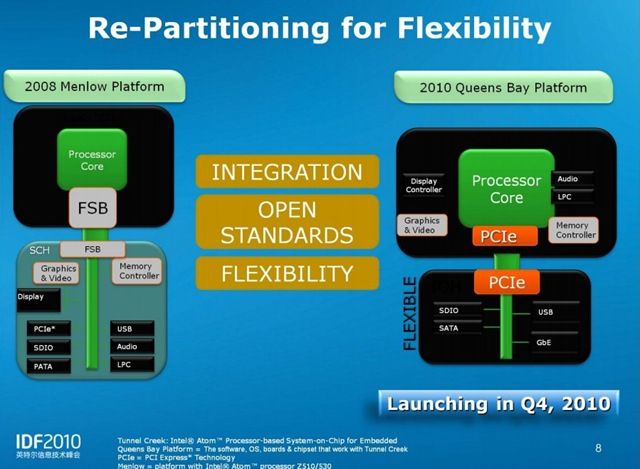
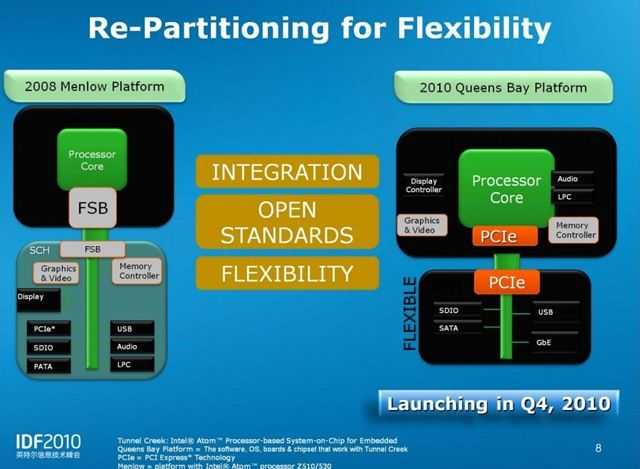
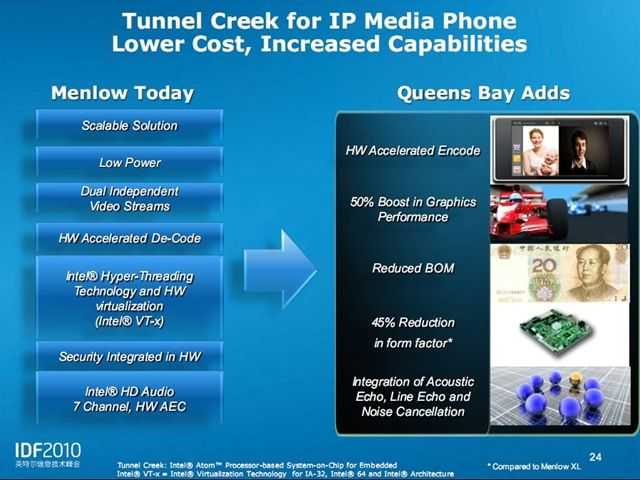
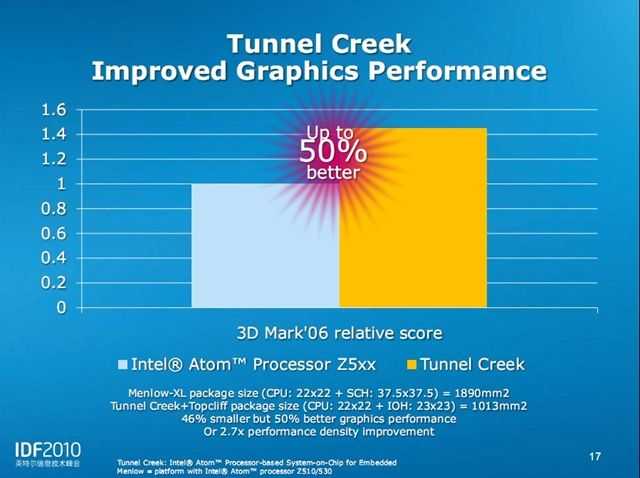
    Oaktrail is similar (but includes components to allow it to support Windows) as is Tunnel Creek. Tunnel Creek (E6xx CPUs) is intended for embedded designs but contains the same graphics core as Moorestown and Oaktrail. With 2x the 3D performance of the older Menlow platform  and a 20Mbps-capable hardware video decoder and 720p encoder, all based on PowerVR technology, it’s interesting to think about performance in terms of a handheld device.

    Have a read at the Intel Embedded site here.

    Intel’s Smartphone Platform and Atom Z6XX Unveiled with 1.5Ghz, Android and MeeGo Capability. Analysis.

    Tags: , , , , , , , , ,


    In a press-release from Intel today they have announced more details on what we know as Moorestown; the low-power computing platform that should take Intel to the historical moment of enabling an X86 mobile phone. The two-component platform will implement the Z6XX processing unit (was Lincroft) containing Atom-based CPU, GPU, 1080p video decoders and 720p encoder, and the MP20 ‘Platform Control Hub’ (was Langwell) alongside a power control module that has previously been referred to as Briertown.


    Moorestown. As seen at IDF 2009.

    Our analysis of Moorestown can be found here.

    Details in the press release highlight much of what we have gleaned before but there are two very interesting bits of additional info. First the summary…

    Collectively these new chips deliver significantly lower power including >50x reduction in idle power, >20x reduction in audio power, and 2-3x reductions across browsing and video scenarios – all at the platform level when compared to Intel’s previous-generation product1. These power savings translate into >10 days of standby, up to 2 days of audio playback and 4-5 hours of browsing and video battery life. When combined with 1.5-3x higher compute performance, 2-4x richer graphics, >4x higher JavaScript performance, and support for full HD 1080p high-profile video decoding and 720p HD video recording, these low-power innovations bring a rich, PC-like visual experience to powerful handheld computers.

    In effect you’ve got a platform that halves the power profile of the previous generation platform while introducing new features that enable lower power states and power control over individual CPU sub-modules know as power islands. That will bring the average platform utilization down to 1W levels (in-use) which, if you’ve done any MID-style activities on a smartphone lately, means it’s in the same ballpark as modern smartphones. Intel’s ‘4-5 hours’ browsing figure is based on using a 5.5wh battery (1500mah single-cell) with all the usual power-hungry components like screens and radios.It’s unlikely to beat the battery life on the best smartphones but there’s another twist here. Turbo!

    These power management capabilities, when combined with Intel® Burst Performance Technology for high-performance on demand, and Intel’s Bus Turbo Mode for high-bandwidth on demand, help to deliver industry leading performance and power efficiency across a range of handheld devices.

    So if you add the low-power idle features with the turbo modes you’ve got a platform that spans a wide range of uses. The smartphone version of the Z6 is going to be able burst to 1.5Ghz [We’ve heard that it nominally runs at 600Mhz] and there will be a higher-power version that will burst to 1.9Ghz and could make a sweet sweet MID, or ‘smart’ computing platform.

    All this new technology is going to need a new operating system and that’s what Moblin was for. Intel built Moorestown and Moblin in parallel so that they would dovetail together. Don’t expect Windows to be running on these platforms.

    Of course, Moblin is migrating into MeeGo (where it will support two competing architectures; X86 and ARM) but there’s another OS mentioned here. Android.

    Why would Intel mention Android and not Windows? Probably because they are working with Google on a X86 version of Android that would slot in well here. Remember, Intel are members of the OHA, the organisation that brought you Android. There’s been no formal announcement on Android yet but Intel are not exactly trying to keep it a secret. How that will sit with MeeGo is anyone’s guess but it does give Intel an important second-string to their bow.

    Update from the fact-sheet: “Intel has worked with Google over the past few years and is providing support for the Android platform at launch”
    Fact-Sheet (PDF)

    Here’s a video of Android running on a Moorestown smartphone from MWC in Feb.

    Additional info: What Moorestown Means for Consumers.

    One last thing to mention is that Intel are now happy to talk about tablets in their PR again. It seems that the old days of hopeless ‘tweener’ UMPCs are behind us now! Personally I think there’s more potential in social netbook-style devices than tablets but that’s another story.

    We’re meeting Intel at Computex next month (as an Intel Insider I’ve been invited to Computex) where I’m sure we’ll hear about launch dates, devices and a whole lot more so stay tuned. The only problem is, does all this belong on UMPCPortal, the productivity-focused mobile devices website, or Carrypad, our sister website devoted to consumer internet devices? Moorestown has the potential of spanning both and that’s exactly the big story here.

    Update: I’ve posted some more analysis of the Operating system options here.

    Z6XX Press Kit
    Press release.

    Lots more Moorestown reading under our ‘Moorestown’ tag.

    Source: Carrypad

    Moorestown. Digging a little deeper.

    Tags: , , ,


    While we didn’t get full details about Moorestown at Intel’s Developer Forum this week, we did get a sneak peak, as Intel love to call it, into what Moorestown brings to the table by the chief architect himself, Shreekant (Ticky) Thakkar.

    Most of it is summarized in a PDF issued to the press but there’s also a set of slides to check out too. See SPCS004 on this content page. Unfortunately I wasn’t able to attend the session but I’ve been through the documents and have pulled out some key features below.

    moorestown-arch

    2x power reduction in use. In real terms we should see what I call ‘on-net’ active power drain (using the device) reduced to under 2W. With the smaller screen devices that will reduce further. This is about double what you’d see on an ARM-based device under similar usage sdcenarios but in terms of getting things done, should be much snappier.

    50x idle power reduction. This brings, for the first time, a PC into always-on scenarios.

    Hyperthreading capability. As we’ve experienced on Menlow, devices with hyperthreading feel faster.

    Burst Performance Technology (BPT) – Monitoring thermals to allow short-term bursting of the CPU clock beyond the design limit. Basically, as other parts of the Moorestown platform are turned off, there is the potential to increase clock until certain temperatures are reached.

    Bus Turbo mode – Allows the bus speed to be increased in line with CPU frequency scaling thus reducing memory latency and increasing bus bandwidth.

    Active power management – Turns off certain parts of the system when not in use. E.g. turn of video decoders when web browsing. Power management is controlled by a ‘profile’ system that identifies certain usage modes and turns on and off ‘power islands’ as required. Here’s a thermal map of the system in a fully-on and controlled (‘gated’) state. This is something that may only be successfully achieved when using a Moblin-based OS.

    power-islands

    Through this technique we should be looking at 2x power reduction overall but in certain usage modes the effect will be dramatic. Standby, video decoding and audio playback modes will be vastly more power efficient. Up to 50x in standby more for example.

    Briertown. This embedded mixed-signal analogue control circuit integrates functions that were previously found on descreet chips. DC-DC power conversion, audio, LED control, battery charging circuits. This module also integrates with the ‘power-gating’ process mentioned above.

    In addition to the information released this week, we should not forget what we’ve learnt before. We’re probably looking at a PowerVR SGX graphics core, hardware decoding video to 720p or even 1080p levels, hardware encoding of video and huge reductions in platform size (about 2x volume reductions expected in devices.)

    CPU clock rates aren’t known at the moment (expect SKUs to be announced in early 2010) and pricing is also an unknown factor that could affect OEM choices but I think that’s enough information to be getting excited about for the time being.

    Note: Moorestown could scale from smartphone to MID and UMPC scenarios, smartbooks and many other product categories. For a look past the technical specifications into what the Moorestown platform could mean for consumers, see this article.

    Intel and LG aim for the Smartphone Market with Moorestown MID

    Tags: , , , , , ,


    Highlighting Intel’s ultimate goal for Atom, the growing importance of a high-speed web experience on a smartphone and possibly Intel’s concern about the speed of development of ARM-based smartphones is this Mobile World Congress announcement that LG and Intel are going to work together on a voice-enabled MID. The first smartphone to be based on what is effectively a PC architecture is expected in 2010.

    No details of the device are available at the moment but you can be sure that LG will already have prototype designs built around the Atom core (on the Lincroft ‘system on chip’) and the Langwell I/O hub. Expect a high-end, big-screen design that, like the recently announced Toshibe LG01, could redefine the size and capability of those leading edge voice communicators called smartphones!

    The announcement also re-confirms timescales for Moorestown and Moblin2 for MIDs and LG is expected to be one of the first OEMs out of the door with Moorestown in 2010.

    Read the full story

    Lincroft, Langwell and Moorestown

    Tags: , , , ,


    lincroft         langwell

    Lincroft is the ‘system on chip’  that powers Moorestown, Intel’s next-gen Mobile Internet Device platform. CPU, GPU, video decode hardware, video encode hardware [Note: Try finding that on the average laptop. Justin.tv needs to watch closely!] and 2D video hardware. Langwell is the comms silicon that connects Moorestown to all the peripherals that are required in a Mobile Internet Device. Its the USB bus, the audio bus, serial, video, etc etc. Think of Moorestown as the bare motherboard which comes pre-loaded with Lincroft, the combined CPU, Northbridge and video card, and Langwell as the Southbridge which provides all the comms interfaces. On to Morestown, OEMs will add memory, power circuitry, comms chips, audio chips, BIOS, storage, cams, mics, speakers and everything else that’s required to make a MID. Hopefuly it all gets wrapped up in an exciting bit of industrial design and loaded with top quality software!

    You can see Moorestown demo’d, kind of, on the video that Engadget got hold of today.

    And what about that ’10x lower idle power’ figure that keeps being mentioned? Well, it means that the platform, that’s Moorestown, will idle nicely. Like a smartphone. All-day. The software will need to be developed such that it powers down all those peripherals that aren’t needed though and as for total system power drain (i.e. How long will a device last on a 10wh battery) I’m afraid its an unknown right now. Moorestown will account for a significant power saving but if an OEM goes and slaps a 2W WiFi module on it…

    Intel have the same problems as all smartphone manufacturers now. It’s about guiding the OEMs and software developers and giving them the right components from the MID ecosystem.

    I didn’t ever expected to be covering voice-capable devices on UMPCPortal but it looks like that’s the way it’s going!

    Moorestown. Working silicon demo’d at IDF Taipei

    Tags: , , , ,


    Comprising the ‘system on chip’ known as Lincroft and the comms chip known as Langwell, the next-generation MID platform from Intel, known as Moorestown, promises to provide smaller sizes and smaller power consumption. At IDF in Taipei today, Intel demonstrated the first working version.

    Chandrasekher said that Moorestown will be a catalyst for exciting and innovative developments that will extend the full Internet experience into the smartphone space with the Communication MID. He indicated that Moorestown platforms will support a range of wireless technologies including 3G, WiMAX, WiFi, GPS, Bluetooth and mobile TV. Additionally, Chandrasekher announced a collaboration with Ericsson* for HSPA data modules optimized for the Moorestown platform. He also announced that Option* is extending its collaboration for HSPA modules to the Moorestown platform. These 3G modules come in 25x30x2.x mm small size, are optimized for Moorestown power requirements and will help provide MID users with more powerful, always connected Internet-based experiences. [press release]

    idftaipeimids Don’t expect too much information about Moorestown this week though as Intel have already stated that the next announcements are to come at the Spring IDF in 2009. In fact, if Menlow is anything to go by, the timeframe between first demonstrations and product availability will be about 18 months. We’ll keep an eye out for videos and details about Moorestown though.

    Looking at the MID display from the technology showcase, I don’t see anything new there either. Keep any eye on the IDF photo stream at Flickr. Maybe something will turn up.

    Search UMPCPortal

    Sales Information


    Our Network

    • ARMShowcase Tracking ARM-based mobile products
    • Big Beach Our marketing advisors. Located in UK.
    • Carrypad Tablets and consumer mobile products
    • Chromebook News Chromebook news, products and specifications
    • Device Manufacturer List List of all device manufacturers, and products, from our database
    • JKKMobile JKKMobile – Mobile computing and hacking – Partner of UMPCPortal
    • Liliputing Netbooks and small-form-factor laptoping – Partner of UMPCPortal
    • MeeGoNews News, reports and inside info from the MeeGo Ecosystem – Partner of UMPCPortal
    • MeetMobility Mobile computing podcast broadcast every two weeks – Partner of UMPCPortal
    • Netbooknews Netbooks and other mobile devices – Partner of UMPCPortal
    • Ultrabook News Ultrabook products, specs and news

    Donators (Last 20)

    Buy Laptop (€5.00 EUR) Says:
    Sep 18, 2011 at 7:43 am

    Awesome website, great read!

    Jez@SammyTablet Says:
    Oct 15, 2010 at 8:25 am

    Keep up the good work! UMPCPortal and Carrypad are always a good read :)

    MiKeN (€5.00 EUR) Says:
    Oct 15, 2010 at 5:13 am

    Microsoft AutoRoute Says:
    Sep 3, 2010 at 10:46 pm

    Trip planning and satnav software for PC

    MMORPG Says:
    Oct 6, 2009 at 2:07 am

    Keep up the great work on UMPCPortal :)

    Laptop Computers Says:
    Jun 9, 2009 at 8:00 pm

    Laptop reviews, ratings and netbook computer buying guides.

    Laptop GPS World Says:
    May 10, 2009 at 2:01 pm

    PC GPS SatNav reviews and forums.

    Ultimate-Netbook Says:
    Apr 11, 2009 at 2:48 pm

    Ultimate-addons supplier of netbook accessories

    Steve Paine Says:
    Apr 2, 2009 at 8:44 pm

    Test from Steve