
Tag Archive | "mids"

M&M&Ms What IDF09 meant for Mobility.

Tags: , , , ,


midmoves-final1 I took MIDMoves to the Intel Developer Forum in San Francisco last week with a focus on the three M’s of MIDs, Moblin and Moorestown. IDF is the highlight of my mobile computing year and I was hoping to see Moorestown MIDs being demonstrated, the launch of Moblin 2.0 and a bunch of new products. As it happens, we got the expected Moblin 2.0 launch but didn’t see much in terms of hardware. We did get a few surprises though and as usual, in-depth information that helps us predict what is going to happen in 2010 and 2011. Here’s a summary of the Intel Developer Forum 2009 for a mobile computing perspective.

Read the full story

IDF09. MID News Round-up.

Tags: , , , , ,


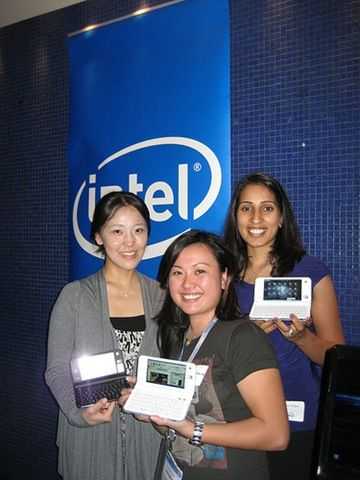
meetupgirls I’m just a few posts away from completing my Intel Developer Forum 2009 related work now and it’s time to round-up and summarize the news and to try and work out what it means for 2010 and 2011. Power-gating, Mobiln 2.1 and the App Store are just three very important elements but for the full overview, check out an article I’ve just posted at UMPCPortal which goes over everything I learned. I can not deny that it was disappointing not to see more Moorestown prototypes but the news is more than enough to keep my excitement going until the next big event. See you at CES 2010 in January.

IDF round-up at UMPCPortal.

Image via. Intel

Many thanks to Intel and the Intel Insider program for the sponsorship of my MIDMoves work at IDF.

Post-Ultra Mobility Event Q&A with Intel

Tags: , ,


anand I had a chance to meet Anand Chandrasekher, senior vice president and general manager of Intel’s Ultra Mobility Group, after the Ultra Mobility Event today and (apologies to the other bloggers in the room) managed to ask a whole bunch of questions. Some couldn’t really be answered in detail but here are the highlights.

Moorestown supports 720p encoding in hardware. We knew it had hardware encoding but we didn’t know the performance level. It looks like we could see some nice streaming video solutions.

MS Windows will be supported on a ‘version’ of Moorestown. You won’t see the same power efficiency under Windows when compared to Moblin 2.0

IMG_9427When Intel talk about ‘Platform’ efficiency, that are talking about the full product including radio’s and screen. If we take the ‘50x platform idle power reduction’ over Menlow (which idle’s at something like 5W in worst-case scenarios on MIDs like the Viliv S5) we’re looking at around 100mw which is very impressive. Previously Intel had announced a 10x reduction but 50x is the current figure.

There are three software vendors working on UI offerings for Moblin 2 on MIDs. Canonical. Wind River and Asianux

There is no detail on Moorestown timescale. Party line appears to be that they will have Moorestown ready by beginning of 2010. If seeing that it might be accelerated.

Menlow will still be refreshed even when Moorestown is released.

Intel says that Moorestown will provide a far better smartbook experience than ARM-based products

The power ‘envelope’ of Moorestown is 2W.

Intel don’t think ARM will be able to compete with Intel on performance or (internet) compatibility. They want to maintain their performance and compatibility lead.

In general I was very impressed with what I saw today. It’s still hard to believe that MIDs are now in the smartphone space. Unfortunately we didn’t get the chance to make a voice call and we didn’t have a lot of hands on but there are a few videos being processed so keep an eye on YouTube.

Productive Microblogging Devices and Why Tweetdeck makes MIDs Very Attractive.

Tags: , , , , ,


microbloggingdevices

June 27th. Updated. See below.

With the launch of the new version of Tweetdeck yesterday, the Twitter microblogging platform moved another step forward to becoming the de-facto online real-time tracking, trend-searching, url promotion, status update, and ‘friending’ tool. The user base is already huge, growing quickly and consists of a lot of young and mobile users. As far as a target audience goes, this is the best one yet for a high-end mobile computing device.

Back to Tweetdeck for a minute though because it’s that desktop experience that really takes Twitter into a new dimension. While twitter.com, the front-end, offers a simple 140 character posting platform, Tweetdeck (and to a large extent, comparable desktop clients like Twhirl and Spaz) offer a standalone client that wraps the service up with tools ranging from search term tracking to translation and includes in-line URL shortening, direct links to online Twitter-related web services, multi-column views, grouping and more in a very efficient, if large-scale, user interface. It’s not only a way to organise your consumption of twitter data but, if you learn how to use it efficiently, it’s a productivity suite too. Once you get used to all the features and that productive process, it’s very hard to go back to the simple twitter front end. The same problems also occur when you try to go mobile with twitter. The mobile clients aren’t powerful enough and don’t offer the screen size needed to get the most out of it the twitter ecosystem. In my experience, productivity on the platform drops and you end up back to that 140 character to-and-fro.

With this in mind, I’ve been thinking about the ideal microblogging device again but this time, rather than imagining what the best device could be like, I took the requirements and tried to map them onto devices that are available (or almost available) today. Desktop clients, productivity and the full web experience was in my mind throughout this process.

Read the full story

MIDs, Mobile Internet and the future of Microblogging.

Tags: ,


tablemids

Wherever they are, at any time of the day, in almost any situation, microbloggers are using the Internet alongside dedicated software, a distribution platform and pocketable hardware to post their message in a quick and concise way. They wouldnt be able to do what they do without the mobile Internet. Almost everyone I spoke to at MBC09 in the last few days had a data plan on their phone and many were using 3G on their netbooks. These fast-moving microbloggers are big consumers of the mobile Internet.

140 characters of text isn’t a lot and even the most basic of today’s mobile phones can handle it but there are a few elements to it that are pushing the mobile Internet envelope. I also see a possibility for future developments where the media creation moves over to a third device, a camera-centric device, which could be a very interesting area for MID OEM’s to look at but first, lets look at a couple of things that highlight why microbloggers are at the front-line in mobile technology and mobile internet usage.

Number one is immediacy. Microblogging tends to be something you do parallel to other jobs. You cant wait 30 seconds for a device to connect to the Internet and a web browser to start and load the m.twitter.com website. You need fast-loading or omni-present applications with well thought-out user interfaces and that’s why there were a ton of iPhones around at MBC09. It’s clearly the current winner in this department.

The second element is linked content. Microblogs are more often than not, ‘leaders.’ They lead you to a web page or other Internet-based media and this is where the full web experience and processing power comes in. If a friend sends you a recommendation, you’re going to want to look at it immediately. If you cant get to that linked website or cant see/hear the media then you’re left hanging. A powerful web browser that offers you a full web experience is absolutely key otherwise you’re going to loose that information. Some microblogging tools do allow you to mark an item for future reference but in most cases, ‘read later’ equates to ‘forget’ and even if you do go back to that item later, the nature of microblogging means that it could be too late. This is an area is where some advances are needed. This is perfect territory for MIDs. They do the mobile Internet better than any other category of device and they dont kill your phone’s battery-life in the process.

There is a small problem here though. The need to microblog can come at any time and while many microbloggers also carry a video or photo device, the current generation of MIDs haven’t focused on media generation. A third device is a hard sell, even if it smooths the micro-media process. But there could be an even better solution here.

There’s a good possibility that media-creation, thats HQ video, images and audio, could merge with mobile computing in a single device. When I was with Intel at the developer forum in San Fransisco last year I heard that Moorestown, the next-gen processing platform, would include hardware video encoding support along with even smaller component sizes. Thinner , lighter, media creation-enabled mobile web powerhouses is a real possibility and Intel aren’t just working on hardware either. There’s a huge ecosystem of software partners (including familiar Web2.0 names) that are writing dedicated software for an in-house Linux-based distribution known as Moblin. Intel know that it’s not just about silicon, it’s about efficient operating systems and applications and it’s exciting to think about how one could potentially create very high quality content, post-process it and send it out to multiple content distribution platforms all within the same system and, possibly, within the same application. Imagine one of those Kodak Z16 HD cameras being able to run Web2.0 software and a full browser!

Im really confident that i’ll be able to attend MBC10 with something that really turns some microblogging heads but in the period between now and then, how will microblogging evolve? The simple 140 character platform will remain because it’s simplicity is attractive but in parallel, I think we’ll see a multimedia version of microblogging emerge. It may take the form of a third party integration service like Friendfeed but I think its more likely to grow in the form of refined blogging platforms that keep the media under one banner. This probably wont be something that everyone will use but these near-live ‘blogstreams’ could be extremely popular with microbloggers, pro-bloggers, marketing teams and Internet journalists. The idea is that alongside your 140 character ‘leader’ you add in the media you want in near real time. There’s nothing new there as bloggers have been creating near-live media-rich postings for a long time but the exciting part of it will be that the content will be created by the same device that you edit and send the microblog from and that it would appear in high quality. Think about creating hi-res photography, post processed on the same device as you took it on, HD video content recorded simultaneously in high and low quality formats, high quality multi-channel audio recordings and each tagged with location information and linked to maps. Think about having a single UI to do all this and manage the delivery of the content through to your personal or business website along with the short ‘teaser’ to the common microblogging platforms. It would be quick, high quality and the best bonus is that you keep your own content under your own brand under your own hosted website. It’s multimedia microblogging and it fits well with the MID platform.

I’m going to keep a close eye on the microblogging community. They are already lashing-up methods to do this and listening to their experiences will be an important part of understanding the mobile Internet timeline and where it’s going in terms of multimedia.


This post written and posted from the Wibrain i1 MID on the train home from MBC09

MID + GPS Dot-to-Dot

Tags: , , ,


koeln
Update: The live dot-to-dot maps are on this page.

Today’s 5-country tour was really meant to be a test of the Clarion MiND MID. Unfortunately it didn’t turn up in time (it arrived 3 hours after I left. I’ll test it out next week now.) so instead I did a live map-track with embedded media. Of course, setting yourself a tough driving schedule and then trying to do live media, on your own, doesn’t fit ogether too well so I wasn’t able to give it the attention it required. I learnt a lot though and it will all come in for the event I have planned tomorrow. It’s another GPS-driven event and it’s taking place in Cologne. I’m going to create a dot-to-dot picture by walking around Cologne and registering waypoints. These waypoints will be logged at Ipoki and accompanied by a location-enabled tweet and an image. You could follow me all day and join the dots as you see the tweets but I guess you’ve all got far better things to do. I’ll be uploading each part of the dot-to-dot (it’s a word) as I finish it and you should, if the GPS doesn’t play up, start to see a word form during the day. I’ll put a new post up in the morning so come back regularly to see progress and guess the word.

The whole project relies on me being able to plan the dot-to-dot on Googles ‘my maps’ system and then using it to locate myself within Cologne. The images and tweets don’t need a MID but exporting the data from Ipoki and re-importing it into Google, does. The GPS and a live-feedback from Ipoki about my current location will also be helpful.

I’ll start the dot-to-dot at about 1100 CET so if you’re in Cologne, find me and say ‘Hallo!’

This is my last attempt at a GPS-enabled mashup so hopefully I remember what I’ve learned from previous attempts and make a good job of it. At the very least it will be good exercise for me! On Thursday I travel to Hamburg for something a bit more like real work. I’ll be meeting Nicole and attending MBC09, a Microblogging conference. I’m really interested to see what microbloggers think of the MIDs.


News Discussion

Commenting continues long after an article has left the front page. Keep up with the latest updates on our discussions page

Become a Member of UMPCPortal

Join the forum and join us for discussion about all aspects of ultra mobile computing. Ask questions about devices and usage scenarios and learn from owners and experts. Join up here. If you're already a member, login here.