
I’ve uploaded the ‘best of’ my CeBIT photos to Flickr. A slideshow is embedded below but you can also see them here.
Hands-up who’s a big fan of having a decent camera in a smartphone? Hands-up who likes pushing photo’s direct to Flickr while on the go?
Hands-up who would like to take this to the next step and to have high-end on-cam editing of images, post processing and a built in full-screen browser with which to use the amazing range on online applications. Add a 3G connection and you’re able to all that while on the go. Having a great camera on a MID (or MID on a great camera – how about that for a modern data-back!) is something I’m looking forward to and when you add on-device video processing (live or post), live streaming, multiple high-brightness LEDs, concurrent, multi-format video recording, audio-only capabilities, background uploading to a web server, and a huge 4.8″ 800×480 screen, you’ve got something very special.
I’ve been testing out the camera on the Compal MID which is, for the first time on any MID, UMPC or Netbook I’ve tested, a reasonably good quality auto-focus 3mp device. With the high-brightness 4.8″ screen you get more than enough of a viewfinder, there’s a dedicated two-stage focus-and-shoot shutter button and on-screen controls for brightness, shutter and resolution. White balance is automatic as is aperture/shutter speed adjustment. There’s an override for brightness too.

I’ve taken some test shots and as you can see, the results aren’t that bad. The color balance seems good, there’s minimal flare/fogging and the auto-focus is working well. There’s a lot of compression though and it would be nice if there was an option to get a less compressed image. The shutter takes a long time to react after pressing the button too which is something you need to be careful of.
More photo’s at Flickr. Uploaded direct from the Compal MID
through Flickrs browser-based tools.
Video quality on the device I have here isn’t up to the same quality as the images unfortunately. The quality is low-end smartphone level and should really be much better. There is a nice one-touch Internet broadcast application included (using Livecast) but again, the video quality is no better than what you might see from a smartphone. The video side is a little disappointing.
If the video support can be improved and the software layer improved to allow for a bit more creativity and some streamlining of posting to websites, blogs and microblogging services, this could be make a great near-live Internet media production device. As we move forward, I’m sure we’ll see a lot of improvements in this area. With citizen journalism, high-speed microblogging and moblogging becoming more and more popular, this form factor with this spec, this screen and this keyboard make absolute sense.
I took a walk to the horses this afternoon; a live media-walk for MIDMoves to test out some geographically-tagged capabilities on the big Web thing. Tracking is nothing new. Location-based tweets and near-live video posts are nothing new. Putting it all together in a media-rich way and being able to show it live is something different though. It highlights the difference between a smartphone and a PC-based MID or UMPC. There’s just no way you can tie all the components together and post-process it into a presentation like this with a smartphone. Having access to full-screen Web2.0 applications and smooth multi-tasking was the key here. There’s lots of improvements that can be made but this is a great step forward for live, media-rich tracking.
Move and zoom the map below and click on the icons for videos, audio recordings, tweets and images.

Source: MIDMoves.com
Thanks to Mobilxfor the i1. Ipokifor the live tracking app.
Source: MIDMoves.com Thanks to Mobilx for the i1. Ipoki for the live tracking app.
Watch out next week for a very special live geo-media tour on MIDMoves.
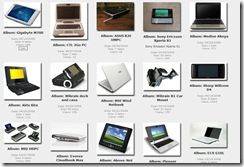
A lot of you already browse the gallery of UMPC images but most visitors don’t even know it’s there so here’s a little plug as we reach 2378 images!
You’ll find most, if not all 140+ ultra mobile products represented with some press images, guest images and a stack that we’ve done ourselves over the last 2 years. There’s pictures of UMPC’s in-use, out-and-about and even some of me in the bath!
Feel free to use any for your own use but don’t forget a friendly link-back!
My most recent live-tracked UMPC photoblog went a lot better than the one I tried to do before and the main reason it worked was because I turned off 3G on my mobile phone thus extending battery life by over 100%. Smartphones still have a battery life issue in these online scenarios though and my own battery sill died before I got home but at least it lasted 3hrs and 10minutes which is a lot more than the hour or so that I had when I last used live tracking with 3G enabled. As a results of the ‘success’, I thought I should make some notes to help others thinking about doing the same thing. UMPCs allow real flexibility in the way you handle your media when you’re out by giving you access to a wide range of desktop computing tools. They also enable rich editing capabilities and even live video sessions with embedded chat as we do on UMPCPortal Live. The method I’m talking about here is one with live tracking using a Nokia N-Series phone and the Nokia Sportstracker app but don’t forget there are other methods too. A cheap GPS tracker (Garmin Etrex for example) is a very flexible way to add geo-location info to your existing equipment and to give you the ability to lay a track over a Google Map. The battery lasts a lot longer too! Read on for more information on the setup and method.
Taking a picture of your photography kit means you have to use an old phone camera. Sorry for the poor quality!