A few weeks ago Intel posted 2 videos featuring Chromebooks and they appear to be part of a bigger campaign to push ARM out of the market. Clearly Intel thinks that there’s something big worth fighting for here. The videos lead to a set of 15 Intel-commissioned reports from Principled Technologies that are all available to the public and listed below.

Tag Archive | "Report"
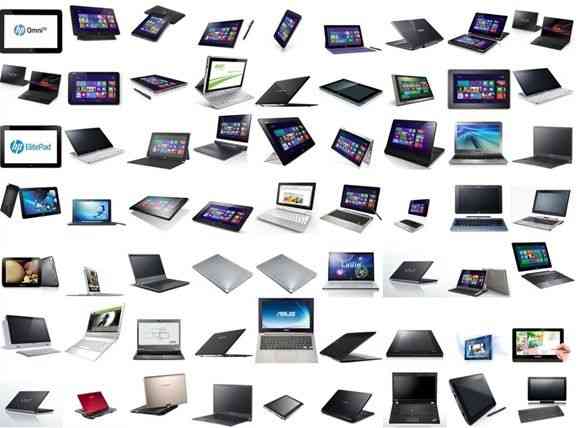
Find The Rightsize, Rightformat Mobile PC
Posted on 07 October 2013
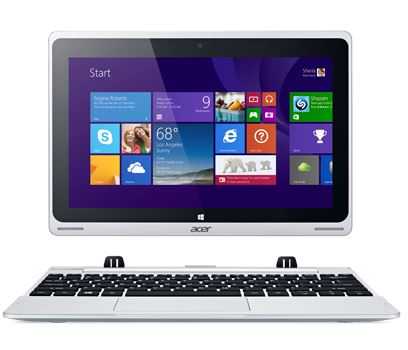
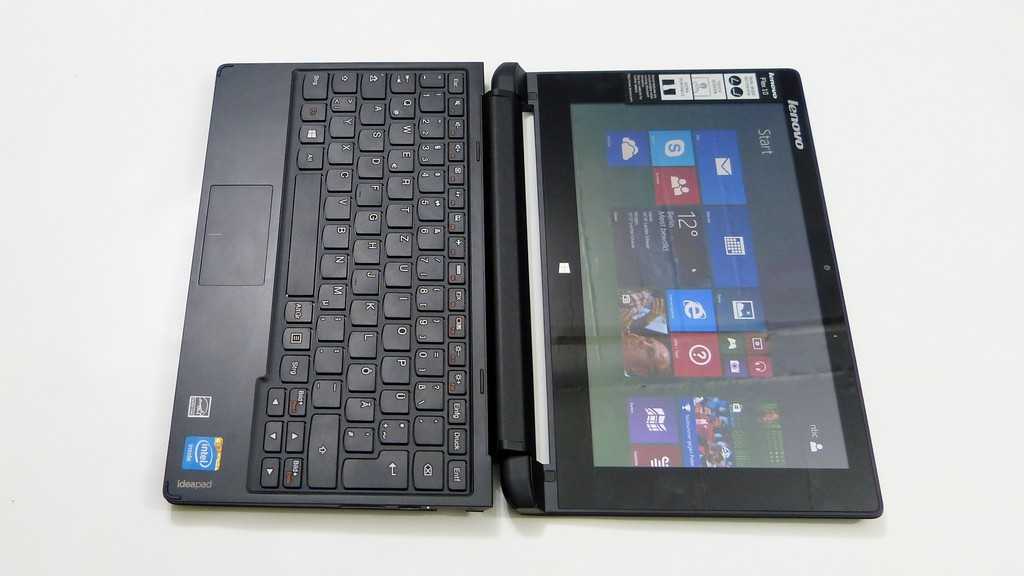
Let’s take a look at what you can do with 8 to 10-inches of hardware and what’s going to give you the most satisfaction. Whether you use it in bed, on the table or in public is important and of course there’s the big question of mixing business with pleasure. I’m talking about small-screen Windows tablets, ultramobile laptops, ultrabooks and the 2-in-1 devices, of course! What’s best for you?
Read the full story
The Case for the Converged Smart Camera.
Posted on 29 August 2012
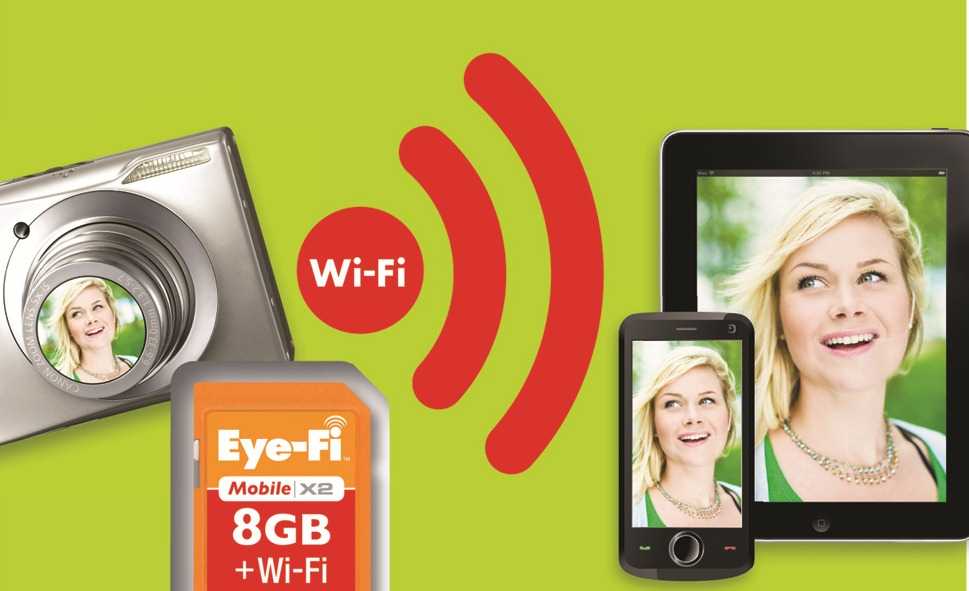
At HiBlue, the focus is on the next generation of smart cameras – cameras that are fully converged with a mobile operating system and communication options that we see on smartphones. The devices haven’t hit the market yet but they’re coming. For some they’ll be an exciting and creative enhancement to photography but to others, they may not be the best solution.
The case against Smart Cameras say they are too converged and that a modular solution of dedicated camera and separate smartphone or tablet-based app/communication hub is better. Eye-Fi have been promoting this type of solution for a while now and separating the camera and ‘smart’ device’ is also the core of the Samsung Smart Camera strategy for the time being. So what’s the real deal? What are the advantages and disadvantages of the next generation of smart cameras?
Ultrabooks For Deutschland
Posted on 24 July 2012
One in ten of you reading this article are from Germany, a country that leads the world in Ultrabook availability. How do we know this? We know this because we regularly scan retailers in USA, Germany, UK, Canada, France, Italy and Australia for information on pricing and availability for our database and Germany is always out front.
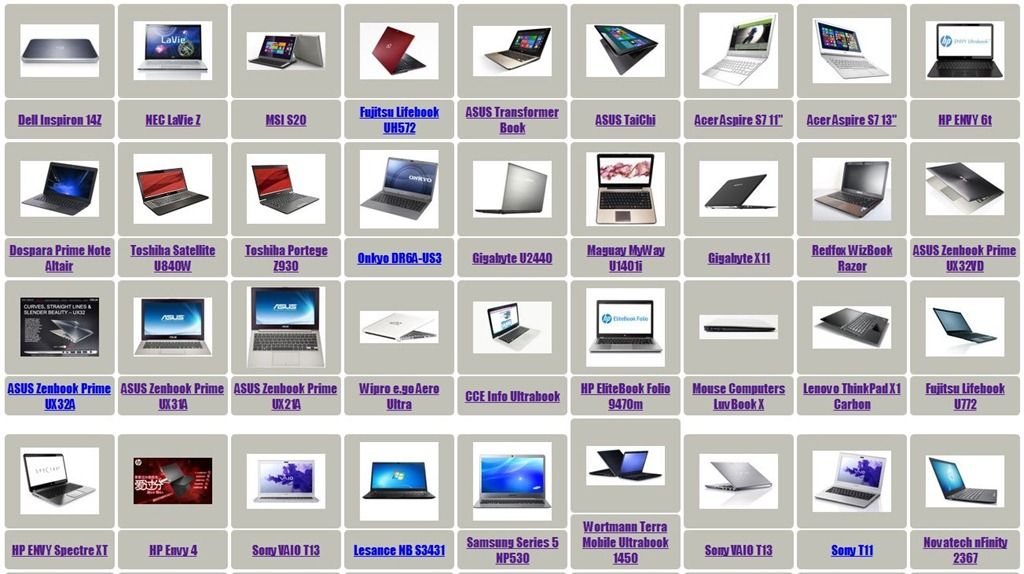
Those of you that think the English-language countries are the place to look for Ultrabook trends, reports, sales numbers need to think again because not only is there a huge availability of Ultrabooks, the cheapest Ultrabook is close to the $600 mark (pre-tax.) 599 Euros buys you the Lenovo U310 today – inclusive of 19% sales tax which most EU businesses will claim back.
Here’s a list of interesting Ultrabooks, including my comments, that you might want to look at if you’re a QWERTZ person. Pass it on to your German friends!
Report: Smartphone Screens Growing over Time, 5? Screens the Norm by End of 2013
Posted on 08 February 2012
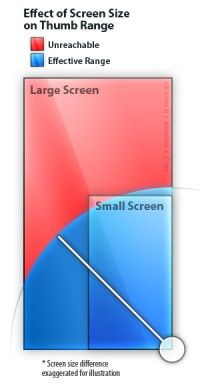
I’ve been following a disturbing trend over the last few years as the Android platform (and now WP7 as well) matures. Smartphone screen sizes just keep growing and growing, and they don’t seem to want to stop. I have a number of issues with smartphones that have overly-large screens. It pains me to see that, while Android is known for giving users many choices, it’s nearly impossible to get a reasonably-sized flagship phone. For me, for a smartphone to be a ‘smartphone’ at all, and not a tablet, it has to be easily usable with one hand. Of course then the definition of smartphone/tablet will change from person to person, because our hands are not all the same size, however, there is certainly a finite limit for everyone where a phone will become too big to be comfortably used with one hand.
I’m currently testing the Samsung Galaxy Nexus. So far it’s been a rather wonderful phone, and I recently wrote this on Google Plus:
I’ve been using the iPhone for 3 generations. Right now I’m testing a Galaxy Nexus. If they made the same exact phone in a size that’s actually comfortable for one-hand use, I might call myself an Android convert. Curse you 4″+ screens and the awful fad that you are!
For me, the 4.65″ screen on the Galaxy Nexus is just too big. I constantly have to shuffle the phone around in my hand because Android places the two most frequently used aspects of the interface (the menu buttons and the notification drawer) at opposite ends of the phone. The size of the phone and the required shuffling means that I’ve got a poor grip on it, and I’ve been rather worried about dropping it during use. Again, those with larger hands will not have the same issue at 4.65″, but at some point they will run into the same problem.
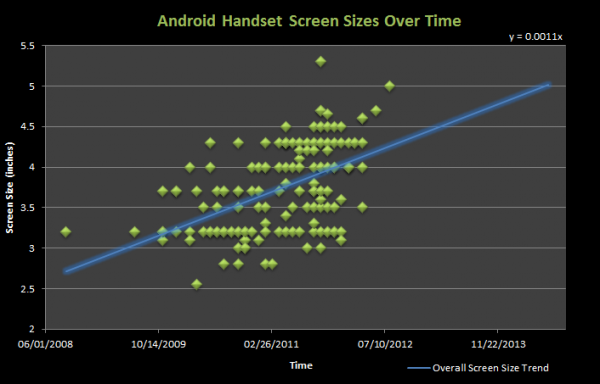
Android Handset Screen Size Over Time
To show the trends of Android smartphone screen sizes over time, I compiled screen size and release date data from 155 smartphones from five major manufacturers (Motorola, Samsung, HTC, Sony, LG). I’d like to thank PDADB.net for their comprehensive release date info. (click to enlarge graphs)
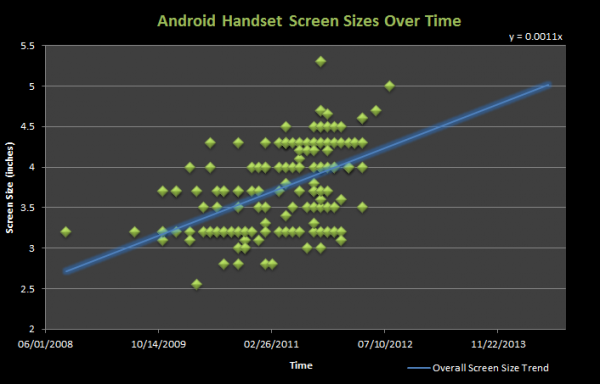

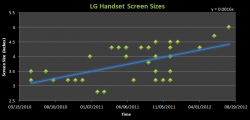
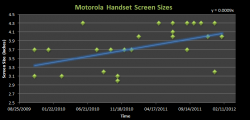
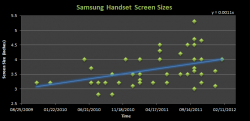
As you can see, since the introduction of the 3.2″ HTC Dream / G1, screen sizes have consistently increased. Today we’re seeing 4″, 4.5″, 4.7″, 5″, and even 5.3″ smartphones! A simple projection (seen on the main chart) suggests that before 2013 is out, many handsets will have 5″ screens, while the flagship phones of that time may have even larger screens (if this trend continues) of 5.5″ or perhaps 6″.
With a slope of 0.0016, LG is increasing its Android smartphone screen sizes the most rapidly of these five manufactures. Despite pioneering some of the largest phones on the market at certain points in the timeline, Motorola is actually showing the slowest rate of increase in Android smartphone screen size with a slope of 0.0009, but of course this isn’t very far off from the leader!
Why is This Happening?
A good question to ask is what’s prompting the growth in screen size. It seems natural for manufacturers to have experimented with screen sizes as the platform grew legs. Different screen sizes are a point of differentiation for an Android phone manufacturer — a way to stand out in a sea of similar options. Bigger screens were also an easy way for companies to try to beat out the iPhone on features, even if the ‘bigger is better’ argument doesn’t hold much water in this case. Now it seems to have turned into a snowball effect whereby manufacturers are trying to one-up each other to have the biggest screen in town (all the while, Apple has stuck with 3.5″ since the introduction of their handsets). You wouldn’t believe how many times I’ve heard the phrase “biggest and baddest” when marketers are referring to a new Android phone. They use this phrase as though bigger is always better, but I must say — when it comes to comfortable one-handed smartphone use — it is not.
Where Does It Stop?
My question is this: where do we draw the line? As I mentioned, despite variations in hand sizes, everyone reaches a limit of comfortable one-hand usability at some point. I don’t have the raw data to back it up, but I believe that Android smartphone screen sizes are rapidly surpassing the maximum size for comfortable one-handed use by the average Android customer. None of this is to say there aren’t advantages to having a larger screen (particularly when it comes to media viewing), but given that people much more frequently use their smartphones for apps rather than media viewing, the argument for surpassing a users one-handed comfort zone to provide a better media experience is a poor one.
It’s not so much that screen-sizes are increasing (the chart clearly shows that other sizes are still available), but the bothersome fact is that it’s near-impossible to get a flagship phone unless you’re willing to buy one of the massive phones on the market. If you want a phone that comes in a size that’s comfortable for one-handed use, you have to be willing to settle as a second-class Android citizen — the only options available to you will likely have slower processors, less RAM (and may be based on an older platform) than the newest and biggest flagship phone currently on the market.
My Top 3 Ultrabooks
Posted on 05 December 2011
It’s crunch time. I’ve been without a decent notebook for months and with CES fast approaching, I need to make a decision. I have a short-list of Ultrabooks and because there’s no-one in this room to discuss it with, I’m going to talk to myself.


Why Ultrabook?
I’ve tested three devices on the ultra-low voltage 2nd-gen Core platform so far and I really like what I see. The dynamic range of processing is just what I need; Quick Sync Video is the solution for my on-the-go video crunching and upload tasks, 1080p video playback is going to be great for home use and at around the 1KG mark, it meets my portability requirements spot-on. 5hrs is the battery life target for average use although anything more than that makes a day on the road less stressful! The Ultrabook platform delivers the perfect balance that I need right now.
The Argument For Ultrabooks
Posted on 31 October 2011
 In this article I put a case forward for the Ultrabook. It follows a similar article in which I put forward an argument against the Ultrabook. You can’t say we’re not assessing all angles on Utrabooknews!
The Ultrabook project, a three-stage plan by Intel to change they way that laptops are designed and manufactured, is now producing its first products and already we’re seeing combinations of weight, price and power that have never been seen in the industry before; Truly ground-breaking notebooks. Early reviews have been very good and despite the expensive changes in design and manufacturing, the price points are competitive.
I’ll talk more about todays Ultrabook products further on in this article but first lets talk about why the Ultrabook project, over 3 years, is advantageous for everyone.
More important than the initial products is the massive change that is being asked of the laptop industry to move to ultra-efficient electronic designs [the battery companies are going to hate this part of the equation. Environmentalists will love it.], sealed unit and single board production by choosing and tightly integrating components and processes. As the change in the laptop continues the result will be advantages for all parts of the industry – a move towards solid state storage, smaller batteries, lower part counts and lower shipping weights. Windows 8 will combine to bring a scenario where the laptop covers a wider range of usage scenarios than ever before. Style included – Dont forget that very important style element for the mature markets.
Ultrabook Buying Tips
Posted on 17 October 2011
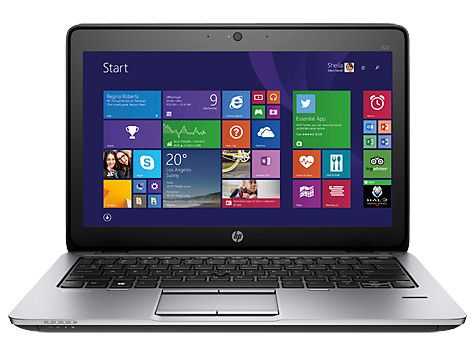
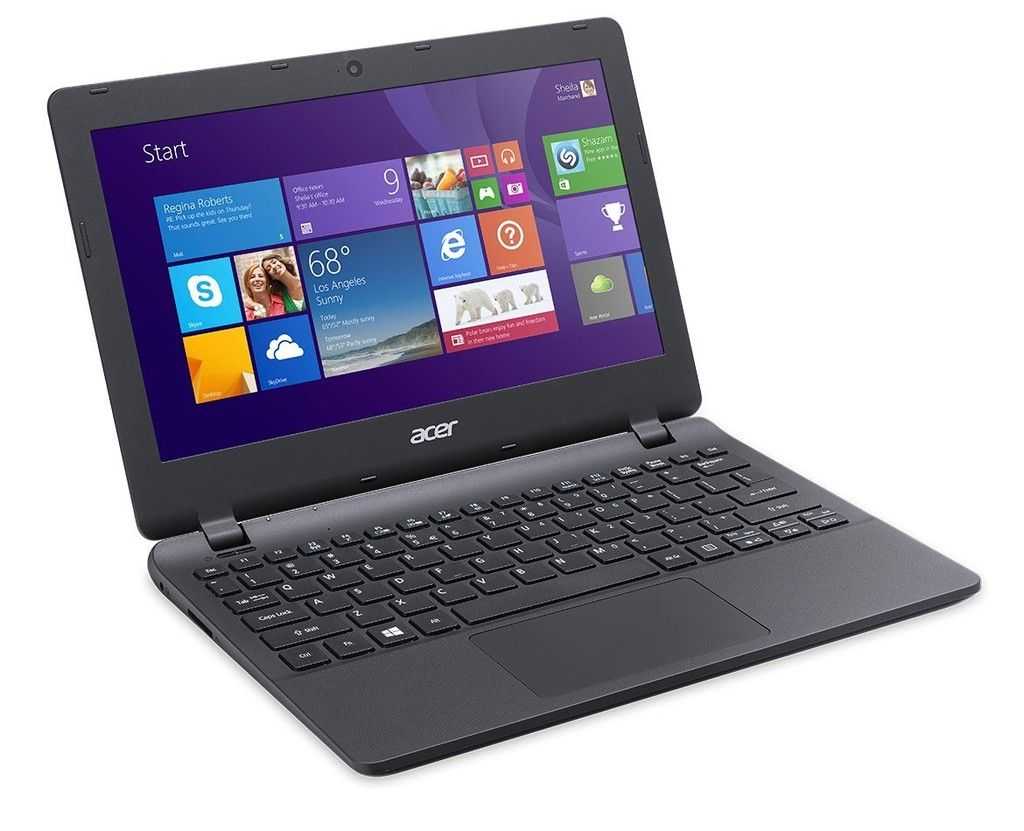
Buying an Ultrabook isn’t going to be simple. Not only do the products all look similar but the internals are similar too. How do you make a choice between an Lenovo Core i5 Ultrabook that looks the same as a Toshiba Core i5 Ultrabook that costs the same? The devil, unfortunately for the consumer, is in the details so to make the process a little easier I’ve listed some hints and tips here that you might want to think about before buying. I’ll update it as often as I can and will add in important tips from anyone that comments below.


Last update: 25th June 2012


 |
| |||
 |
| |||
 |
| |||
 |
| |||
 |
| |||
 |
| |||
 |
| |||
 |
| |||
 |
| |||
 |
|