Posted on 30 July 2008
One year ago (see this post for details of the 2007 Solar UMPC tour kit,) I was using the setup below for my mobile blogging and tracking.
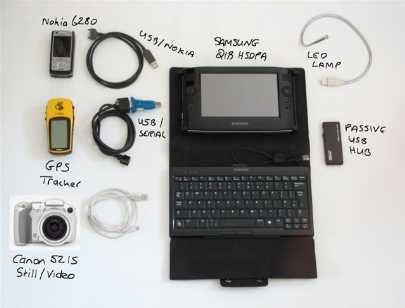
This year, its a lot simpler. And a lot more powerful. Notice how the phone, GPS tracker and Camera have merged into one device. Yes, the N82 is a real boon. The N82 camera is not as good as the S2 (as expected) but the ability to auto-tag while tracking and then post the images directly to a server over the Internet is a massive advantage.

You’ll also notice a change in UMPC. I’m now using the Samsung Q1 Ultra (with XP and HSDPA) which has an SD slot (negating the need for any cables for the camera) and a much brighter, higher resolution screen. I’ve also moved to SSD rather than the traditional, spinning hard drive. Its safer. The keyboard (A Samsung Q1 keyboard) remains the same as there’s still nothing out there that can beat it. You’ll also see the USB LED lamp. Still, a key part of the kit!
Now lets look at the solar setup. This is the setup I used a year ago.
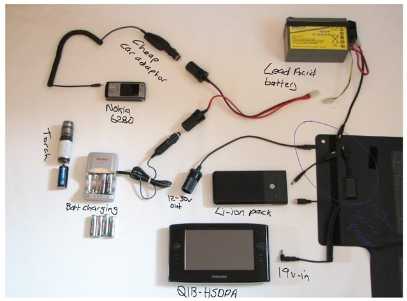
And this is the setup i’m going to use over the next four days while I go work/camping.
[The Wife and Kid are off camping together and I was due to stay home and work but I’ve decided to come along and make a working holiday of it. Dads – this is the beauty of Ultra Mobile PC’s!!!]

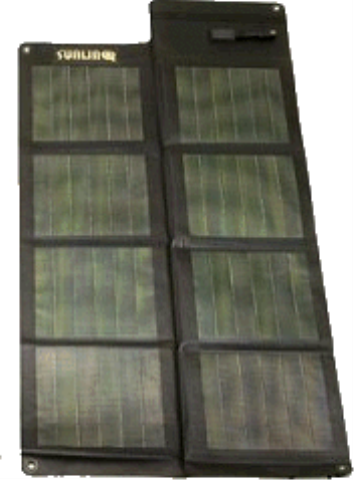
I’ve removed the lead acid battery from the kit and am now direct charging the Tablet Kiosk MP3400. It only charges during peak hours (one full charge per 100% sunny day here in mid-summer Germany) where the SLA battery charges during less sunny periods but the amount of energy you get in those few extra hours is minimal. I’ve chosen to drop the SLA battery and use the MP3400 direct on the Sunlinq 25W solar panel.
Here’s a post with more detail about using the two together. And a how-to video.
I’ll probably post a few solar computing thoughts while I’m away so stay tuned here for more. Weather is looking good!

Last year on the Solar UMPC tour.
Posted on 24 May 2007
I’ve just had a nice conversation with my energy advisors, Select Solar, about some of the issues I’ve seen with the tests I’ve done so far. The main problem being that Li-Ion batteries will not trickle charge. They require a certain level of stable voltage/current before they start to charge and this wastes the possibility of charging a battery at lower sun power. In fact, on a hazy day or with light cloud cover, the sun power might not actually go above 70% and you have no chance to charge anything. This could be major problem and I’ve decided to try and address it.
A solution to this problem, as I mentioned before, is lead-acid batteries. These are the type you will find in your car and are a tried, tested, reliable and relatively cheap solution. The problem is that they are also extremely heavy – at least 400% of the weight for like-for-like power storage. They also operate at 12v which means voltage conversions (and more electronics and power-wastage) in order to operate the UMPC.
The decision I’ve made is to buy a 70W/hr 12v lead-acid battery (2200g) and to try and use this as a charge buffer. Here’s a little sketch of the planned set-up.
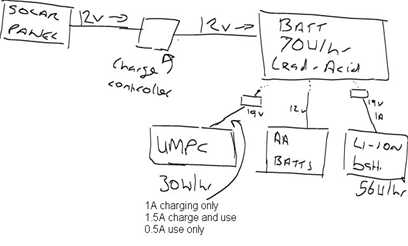
The idea would be that I connect devices to the lead-acid battery as the solar power increases during the day. For example, I might add a couple of AA batteries or my mobile phone in the morning. At mid morning I might replace it with the Li-On battery and during the peak hours I could re-attach the AA battery charger with 2 or 4 batteries depending on sun power.
Two problems I can see here:
- How do you know the charge on the lead-acid battery?
- Will the lead-acid battery be able to feed up to 1.5 Amps?
There’s only one way to find out. I’ve just put an order in for a 70W/hr lead acid battery and charge controller along with some fresh AA batteries, a powerbank tip adaptor for the Samsung Q1, a 12v charger for the mobile phone and something I’ve always wanted, a flexible USB LED-lamp!!!
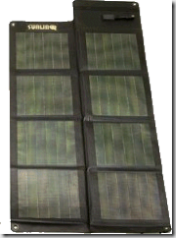 Later today I will probably be ordering the solar panel. I won’t be using the P3 Panel as the only advantage with that was that it could drive 19V into the PowerBank. Now that I’m going for a 12V source solution I’m going to be looking at the 25W version of this Sunlinq panel which is the same price as the 15W version of the P3 panel. There’s a risk that its going to be too big for the bike at 1m long but even if I fold 25% of it away, its still going to give more power than the 15W panel and during mid-day pause and work sessions I hope to get the full 25W out of it.