Location-based services are an exciting and interesting area of mobile computing. Carriers, advertisers, developers and consumers all seem to understand the potential and as social networking grows in popularity, these services could be big sales drivers. If these services become deciding factors for consumers in the mobile device space, mobile platforms that don’t support them will clearly suffer. Leading mobile platforms like the iPhone, Blackberry, Android, Maemo and Symbian that are all based on ARM cores have a big head start over x86-based operating systems and it’s looking likely that it will stay that way.
Consider these points.
1 – It’s likely that nearly every high-end mobile phone will have GPS built-in within the next 24 months. ABI predicts 90% of smartphones will have GPS by 2014. Most early adopters in the Internet space are likely to have a phone with a GPS in the next 12 months, if not already. Nokia are planning to have nearly all N and E-Series phones with GPS within the next 2 years.
2 – Apart from the small numbers of deployed GPS modules on PCs, UMPCs and MIDs, developing applications on a PC that integrate smoothly with GPS remains difficult. Consumers can not be expected to enter COM port and baud-rate details into their software configurations.
3 – Broker services. Why use a local GPS modules on a PC, even a mobile one, when a broker service (like FireEagle ) can not only provide your location to all your cloud-based services but also back to your PC-based app? Because of the PC-based development problem identified above, social networking clients on PC’s will probably take this ‘least-effort’ route in order to tag microblogs and media with location.
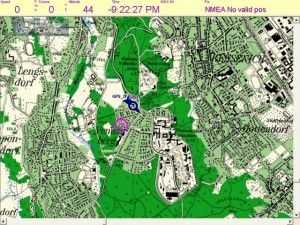
There are of course reasons why you might want GPS on your PC.
1 – Your PC is used for real-time GPS data. (Turn-by-turn navigation, tracking and data collection.) This applies to ultra mobile PC users and CarPC users. Broker services would have too much latency for real-time services. Specific applications and target markets will continue to exist.
2 – Your PC is not connected to the Internet and therefore can’t use a broker service.
3 – Why not? GPS modules are cheap.
The clear likelyhood is that the software developers will continue to focus their LBS efforts on smartphone platforms due to the ease of access to GPS information and the number of GPS-enabled devices out there. There are one or two options for X86-based platforms though. Geoclue and Moblin teams are working on getting this LBS issue resolved for the Intel-based MIDs but they need to work quickly. An Android port could also seed interest in the x86 platform for these applications.
Does this mean that the smartphone wins? Not yet. There are problems that need to be addressed because GPS-enabled applications are dynamic, require a lot of cpu power and a lot of screen space. Mobile phones are low-powered (in terms of CPU and online/gps battery life) and have small screens which make them less than ideal despite their GPS-friendly operating systems. This is why MIDs will come along to satisfy the need for larger screens, larger batteries, keyboards and higher processing power. Significantly, for LBS developers, they will come in both x86 and ARM-based flavours so there will be no need for location-based software developers to change to a new architecture just to get round physical limitations of smartphones. The ARM-based MIDs will be there to fill that gap and provide the perfect platform, in terms of both hardware and software, for rich and dynamic LBS services.
If location-based services become successful it will give smartphone-based MIDs a huge head-start over X86-based MIDs. My personal feeling is that GPS-enabled social networking is going to be very important and is likely to drive sales of devices that support. X86-based MIDs are at a serious disadvantage.
Lists of location-aware software and services:
Are you involved with location aware software development? If so, are you interested in writing software for Moblin or ‘desktop’ operating systems or are you going to focus your efforts on mobile platforms? Which is your favourite mobile platform for location-aware software development?
Note: I haven’t covered triangulation services here as I believe that they only have a secondary role based on their closed architecture, inaccurate results and the proliferation of handset-based GPS modules and open broker services.