Posted on 28 May 2008
 Yesterday, I completed the final part of a series of upgrades that have been done to my Q1 Ultra to bring it up to what is close to my ideal all-round ultra mobile PC device. In this article I’ll outline what I’ve done and give you some detail about my most recent upgrade, swapping the 60GB hard drive out for an 8GB flash drive. The difference is quite remarkable. Not only do test results show up to 4x the read speed and 2x write speed but boot-times are quicker and the overall responsiveness of the system is improved dramatically. If you need convincing that SSD’s are fast before you take the jump, check out the video at the end of the (long and media-rich) post. Note that much of this applies to other devices that use 1.8" drives. The Sony UX, Fujitsu U810, HTC Shift and others.

Read the full story
Posted on 22 May 2008

Most, if not all of you reading this will have heard of the Firefox browser and many of you will have tried Firefox 3.0 beta. I held back from using it for a long time because it was beta software but the latest release candidate seems stable and has me converted on all platforms now. Firefox 3.0 is fast. Firefox 3.0 is memory efficient. Firefox 3.0 has great features and overall its a clear winner on ultra mobile PC and netbook platforms, especially when using online applications.
Like Safari, it appears from my test results that Firefox 3.0 can process java-heavy pages on a Ghz-class ultra mobile PC faster than the data arrives over my 6mbps Internet connection which means that for rich Internet applications, the bottleneck is at the remote server and there’s very little else you can do to speed up the experience. Apparently, java processing in FF3 is many many times faster than in version 2 so this explains the big improvement with online applications. Not only is the speed improved but there are some great features that will appeal to ultra mobile PC users too. But first, here’s some test results. I took 5 devices and ran speed tests on 3 browsers [*1] using reader.google.com as the target page. It’s a java-heavy page and there’s no flash or major numbers of images to process but its typically my slowest-loading browser application. It represents a typical online application and for web-workers, its a good, tough benchmark.
More info after the jump…
Read the full story
Posted on 19 May 2008
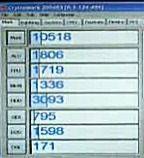
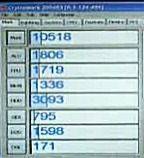 UMPCFever continue their hands-on with the Aigo MID and have been playing with the device running under Windows. While they were there they did a CrystalMark test which gives us the first ever look at how various parts of a Silverthorne-based MID might perform. However, I would take these results with a large pinch of salt as they appear to be on the low side. The memory speed and disk speed figures look especially low so there could be some driver issues. Certainly the graphics figures should be ignored at this stage.
I’d advise to wait for real-life browsing and video figures from the system while running the Atom-optimised Moblin build rather than a vanilla XP build that has never heard of Poulsbo or Silverthorne!
On the image at the top right, from the top are the total score, the ALU test score, the FPU test score the MEM, HDD, GDI, D2D and OGL scores from the Crystalmark test. For a list of ultra mobile PC crystalmark scores, see Ctitanics table of results from various sources.
UMPCFever Aigo MID CrystalMark test video.
Update: A more detailed discussion is continuing on Atom performance details in the forum here.