Posted on 20 May 2008
If Atom is a success and goes the way Intel want it to, this new and rather small sub-category in the Intel Software Network forums could become huge. Really huge.


In a post from Intel’s Jeff Moriarty, you can read about the launch of the Atom Software Developers Community which pulls together a number of developer resources covering the hardware and software that goes together to make an Atom-based devices. Note that it’s Atom-based devices and not Mobile Internet Devices because Intel have plans for Atom that go far beyond cheap notebooks and UMPCs. The ultimate aim is an Atom-based smartphone which completely changes the numbers for Atom. Even if MIDs take off and netbooks become the de-facto choice for students, an entry into the multi-multi-million unit smartphone market would dwarfe everything that Atom had done previously. It doesn’t stop there either. I recall Intel talking about Atom at IDF and CeBit saying that the platform would be so cheap in terms of hardware and software development costs that it could be dropped into consumer goods without having a major effect on the end-user price. TV’s, cars and the fridge could all be Atom powered in the future. Add the obvious industrial applications and the potential market gets very interesting indeed. [More after the break]
Read the full story
Posted on 19 May 2008
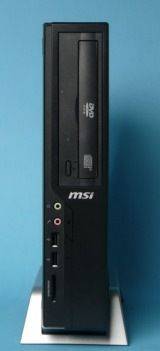
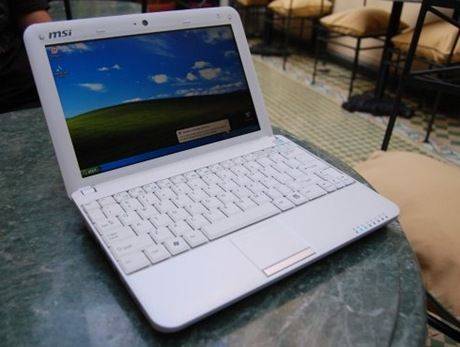
 I have a feeling that today is going to be Atom-benchmarking day as we digest results coming from UMPCFever’s testing of the Aigo MID and now, some test results of a new MSI Wind PC (not notebook) that is based on the 1.33Ghz Atom (Z250) Silverthorne processor and not the low-cost Diamondvile part as you’d find in the MSI Wind notebook.
First point to note is that in this relatively open-enclosure design, the 1.33Ghz Atom doesn’t require active cooling. To achieve the same in a tightly enclosed MID will require some good engineering but its encouraging for those that like their devices to be silent.
There’s a full suite of test results too but the one I want to highlight is a PCMark 05 CPU result and comparison to the Eee PC running the Celeron at 630Mhz.
Atom 1.33Ghz: 1159 (Normalised 0.87/Mhz. Recalculated to 1.8Ghz, approx 1560)
Celeron 630Mhz: 997 (Normalised 1.57/Mhz Recalculated to 1Ghz, approx 1413)
This is a telling set of figures because it shows the result that we’ve been expecting and that is that, clock-for-clock, the Atom processors are less powerful than the older Celeron/Pentium devices but at 1.8Ghz, the Atom Silverthrone processor should be about 10% more powerful than a 900Mhz Celeron.
Is this good? Is this an advancement of processor technology? You might look at the results and say ‘No’ but there’s one important element that has to be taken into consideration. Power-usage. The 1.8Ghz Silverthorne/Poulsbo combo will return these figures with a platform TDP of about 4.5W. The Celeron at 900Mhz would require a platform with a 10W TDP. That’s a 50% improvement in platform efficiency and that’s exactly what we need to see for handheld Internet and productivity devices.
Performance details from PC-Watch. (Translation)
Posted on 19 May 2008
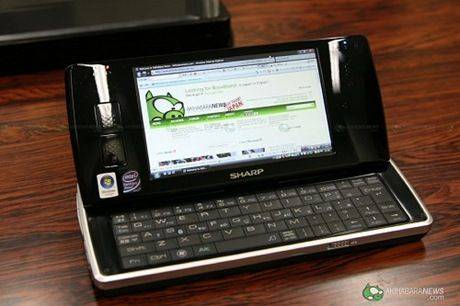
Once again, we sadly have to report that OEMs are trying to squeeze Vista on low-end UMPCs. I’m also hearing that ‘unoptimised drivers’ excuse again… [Deep breath…Gooosefrababa]
Akihabara have done some testing on a Willcom D4 1.3Ghz Atom-based ultra mobile PC which they say has a "Beautiful design, ergonomic, a well thought out keyboard, multiple positions, touchscreen…"
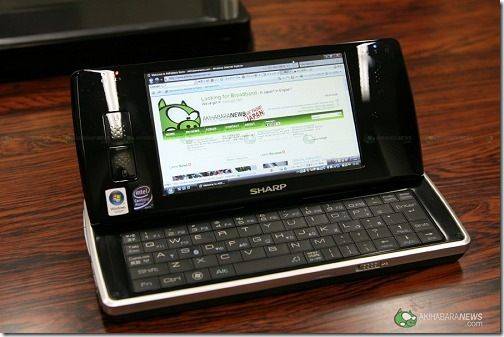
 The device appears quite large in comparison to say the Gigabyte M528 MID and reminds me of the Raon Digital Everun which isn’t a bad thing because I’d be extremely happy with an Everun that used this design and ran Windows XP. Vista, however, is just going to end up embarrassing Sharp and Intel as it appears to do in the video that Akihabara have produced.
You can check it all out at Akihabara. Willcom D4 specs and links are in our database.
Posted on 19 May 2008
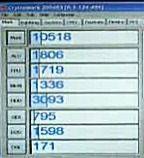
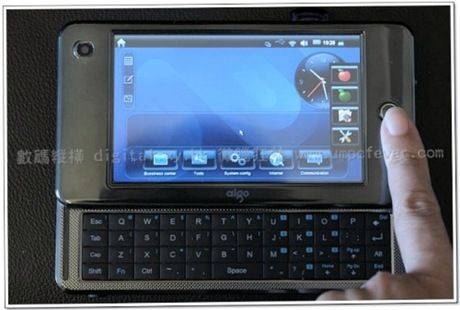
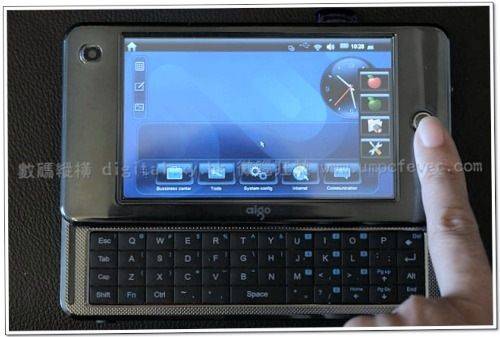
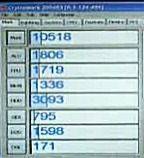 UMPCFever continue their hands-on with the Aigo MID and have been playing with the device running under Windows. While they were there they did a CrystalMark test which gives us the first ever look at how various parts of a Silverthorne-based MID might perform. However, I would take these results with a large pinch of salt as they appear to be on the low side. The memory speed and disk speed figures look especially low so there could be some driver issues. Certainly the graphics figures should be ignored at this stage.
I’d advise to wait for real-life browsing and video figures from the system while running the Atom-optimised Moblin build rather than a vanilla XP build that has never heard of Poulsbo or Silverthorne!
On the image at the top right, from the top are the total score, the ALU test score, the FPU test score the MEM, HDD, GDI, D2D and OGL scores from the Crystalmark test. For a list of ultra mobile PC crystalmark scores, see Ctitanics table of results from various sources.
UMPCFever Aigo MID CrystalMark test video.
Update: A more detailed discussion is continuing on Atom performance details in the forum here.
Posted on 17 May 2008
 Two more items to tick off the list on the 800Mhz Atom MID’s:
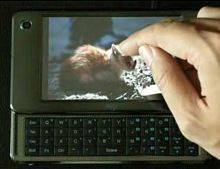
– YouTube appears to play flawlessly.
– The CoolImage application does indeed look cool.
Both videos (linked above) are from UMPCFever in HongKong. Keep an eye out for more!

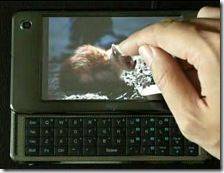
I want to see WMV and H264 at HD though. In theory, it works! Also on my list:
And much more!
Posted on 16 May 2008
The lucky lucky lucky guys over at UMPCFever got an Aigo MID [specifications] test device and have started to publish their hands-on reviews and video. This is the first time anyone has ever really had extended private time with a Silverthorne/Menlow-based device so pay attention as the guys have already got Windows XP up and running on the device although judging by their feedback on the Midlinux2.0 OS build, it’s looking like things are already pretty sweet out-of-the-box. [Commentary after the pic…]
Read the full story
Posted on 15 May 2008
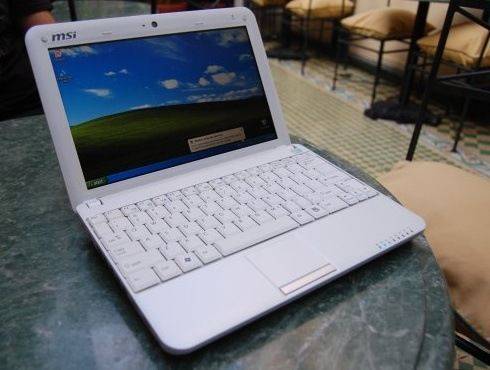
 CHW, a Chilean website presents a brief but glowing hands-on report for the MSI Wind mentioning good keyboard, a cool temperature, and what can be interpreted as a responsive feel to Windows XP. It also mentions battery life figures of 3+hours for the 3-cell battery and 7 hours for the 6-cell which, given the slightly more efficient CPU and, hopefully, a more efficient motherboard design combined with the LED-backlit screen, seem reasonable claims. [More after the pic…]
Read the full story
Posted on 15 May 2008
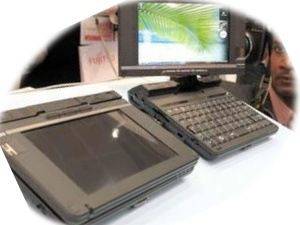
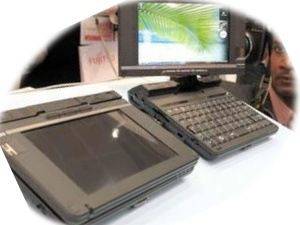 Focusing on the ‘high-end’ of the market, the Fujitsu U2010 that was announced in Korean today will be an Atom-based (we assume Silverthorne/Poulsbo) ultra mobile PC running Windows Vista and including GPS and 3G. One of the problems of the previous U1010, the multi-function keys, might have been solved in this model as there’s a 6th row of keys on the device. Weight is an impressive 610g. Screen is 5.6" at, we assume, 1024×600. I also see a fingerprint reader and SD card reader. There’s no word on processor speed but we can assume that this will be running 1.6 or even 1.8Ghz and a few quick calculations based on a small 20wh 2-cell battery as seen on the U1010 returns a potential in-use battery life of around 3hr which would extend to 6hrs with the commonly used 4-cell battery pack. A local Taiwanese price of $1300 puts it into the middle of the ultra mobile PC pricing along with other 3G-enabled devices like the Q1 Ultra HSDPA and a July launch ties-in with the expected availability of the Intel Menlow platform.
Its good too see some more pro-mobile devices appearing but the success of this little baby will largely depend on how Vista performs so keep any eye out for reports from Computex.
Source: Digitimes. Via JKKMobile