Tag Archive | "pmp"

Viliv S5 Premium UMPC. Full review.

Tags: , , , , , ,


s5hands2

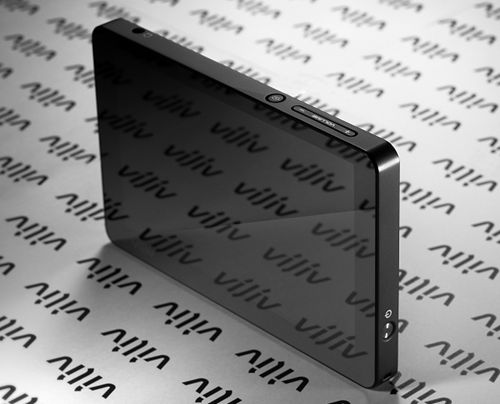
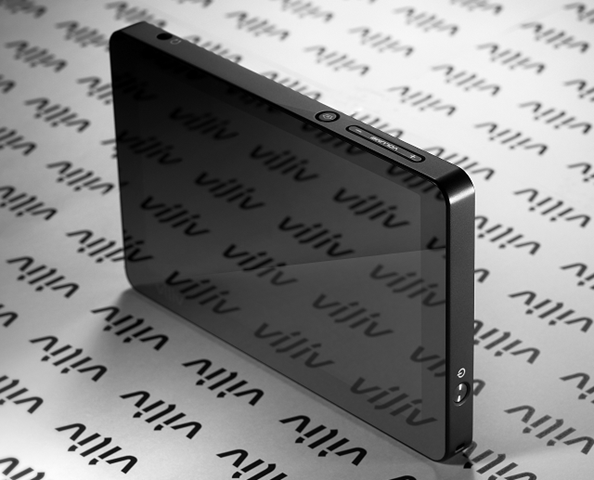
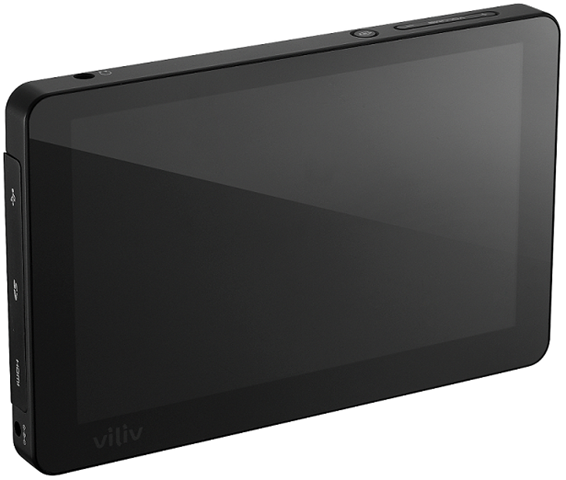
After many months of wondering if the S5 was going to be as good as we first imagined it to be, it’s time to review the final retail version and make some conclusions. The Viliv S5 is one of the smallest tablet PC’s in the world. It includes a full PC hardware architecture and Windows XP software. The manufacturer has used a mature design from it’s PMP range and the end result is a solid, well-built pocketable device aimed at media, web browsing and, due to the built-in GPS, navigation.

Vilis S5 specifications, discussion, links, videos and images in the community specifications page.

Read the full story

Omnia HD. MID, Smartphone and The End Of The Tweener.

Tags: , , , , , , ,


The Omnia HD is something that all MID fans should be taking a close look at. It highlights how close the ARM-based platforms are to Intel’s MID platforms. In fact, in many ways, the Omnia HD looks like one of the best MIDs so far with longer battery life, smaller form factor, 720p video recording and a mobile-focused software suite that addresses new mobile markets. It’s an incredibly converged product but at the same time, you could call it a tweener. Neither a 24/7 phone or high quality mobile internet device.  I intend to re-visit the Omnia HD by testing it in full in the near future but in the meantime, take a look at the specifications when placed side-by-side with the most popular tablet MID of the day and lets think about how the Omnia HD highlights that there is no such thing as a tweener.

S5D samsung-omnia-hd-3
Omnia Image via AreaMobile.

Viliv S5. (Estimated 800 Euros with 3G) Omnia HD 600 Euros Comments
CPU Intel Atom 1.3Ghz (Menlow platform) ARM (Cortex A8) 800Mhz (OMAP platform) Atom estimated 2x processing power.
Wifi BT 3G (data only) Wifi BT 3G (voice and data, HSUPA) Voice convergence is important for some. HSUPA important for Europe.
1024×600 4.8” screen (250dpi) LED, resistive touch. 640×360 3.7” screen (approx 180dpi) O-LED, capacative touch, O-LED will give outdoor readability issues. 640×360 restrictive for web browsing.
GPS (no software) GPS plus Navteq maps and social networking. GPS software for XP is expensive.
5hrs online Est, 3hrs online (based on hsdpa talk-time) For online use, the Viliv wins but the Omnia is more efficient.
10hrs standby (on, screen of) 600hrs standby (on, screen off) Always-on is important for comms!
Windows XP plus touch UI Symbian S60  plus mobile software suite (TouchWiz) S60 is mobile-focused (some exciting next-gen social and LBS apps available) but no desktop app compatability.
No cam 8mp cam with 720p recording 720p recording is a huge bonus for the consumer.
400gm 125 gm 1/3rd the weight means you can carry an extra two batteries
Video playback – 720p flexible support, 6hrs Video playback – 720p, 4.5hrs Similar video capability. XP comes with only WMV support out of box.
Storage 60GB Storage 16GB + Micro SD Big storage on the Viliv compared to Omnia.
Browsing: Desktop quality, sub 10-second average, full flash and plugins Browsing: Limited quality. Estimated 20s page load time. Omnia browsing will fall way short of a desktop experience.
3D graphics: Power VR SGX 3G Graphics: Power VR  SGX Snap!
Accelerometer Good for navi, web, ereading
FM Radio A useful, very low power information source. (Local Traffic, news, music, events)
Component, S-video out, VGA HDMI Out Digital output on Omnia turns it into a better set top box.
Best USB device support Limited USB device support If you have USB devices, they are likely to work better with the Viliv S5
Full desktop software capability Mobile-focused software capability Viliv S5 allows you to carry on using your desktop software. Desktop software is, however, expensive.
Availability: Limited roll-out Availability: Global Omnia HD will be widely available
Brand unknown outside Korea Top-tier global branding. Provides consumer confidence.

Clearly the Samsung Omnia HD has specifications that are very close to one of the best Intel-based MIDs on the market. You’re looking at an extremely capable hardware platform that provides consumer-focused MID, PMP, PVR and PND-like capabilities in a 24/7 voice-capable form factor.  It’s also got mature, consumer-friendly mobile-focused software that tackles new mobile usage scnearios and it’s reached the market before anyone else could with Intel-based MIDs that are targeted at the same usage scenarios.  For some it’s going to be seen as the ultimate converged device and one of the best ‘MIDs’ on the market.

Look at it from another angle though and you see a different story.  If you want a 24/7 phone,  the Omnia HD is very very expensive and for most people, too big.  If you’re looking for the best quality mobile web browser, PND, PMP or microblogging device, it falls short on either screen size, keyboard or software. As with most converged devices, it takes new, exciting usage scenarios and lever’s them into compromised form factors.

What I see with the Samsung Omnia HD is a device that underscores exactly the emerging  scenarios that MIDs are targeted at. It’s providing a taster of things to come.  If these scenarios develop, the new ecosystems created could support dedicated devices that fit in the space between the smartphone and the netbook. With technology like the Texas Instruments OMAP 3 platform and Intel’s Moorestown available to OEMs, it will only be a matter of tweaking the design, the software and applying the right marketing to slot the variants into the new ecosystems.

How about dropping the Omni HD’s internals into a Nokia N810-like form factor and increasing the screen to 4.8” with 250 DPI to improve the focus on mobile geo-enabled social networking? How about adding a powerful photo flash and video editing software to enhance mobile photo capabilities and add how about adding a daylight-readable 6″ screen for a move into the ebook market? Think about an iPod Plus, a Kindle with a fast browser and think about the next Nokia Tablet. A Techcrunch Crunchpad or  a Google Lattitude Social  Tablet.  A Canon/YouTube device  or even a dedicated Vodafone/BBC iPlayer.  I don’t propose that all of these are winning business opportunities but I bet there are a few opportunitues in that list for dedicated devices that people have called ‘tweeners’ in the past.

The real story here is three-fold. The Omnia HD highlights how advanced and flexible the latest smartphone platforms are.  It highlights that new usage models are emerging and that if these ecosystems grow, there will be opportunities for dedicated devices. Thank-you Samsung for highlighting that the MID concept is on the right track and that the end of the Tweener-era is nigh.

Viliv S5 MID/PND/PMP /UMPC (!) Gallery

Tags: , , , ,


I’ve just uploaded a new Viliv S5 photo-set into the gallery. Also on Flickr and embedded below. For more info on the Viliv S5, see the S5 info-page.

Viliv S5 Pre-Orders Sold Out in 15 minutes. Review Information.

Tags: , , , , , , ,


According to the MyViliv website and some information we received by email, 1000 units of the Viliv S5 were sold in 15 minutes today as the pre-orders started in Korea. Viliv have been selling PMPs and other devices since 2005 and they tell us they’ve achieved the highest website statistics ever through the S5 launch.

That’s impressive considering the financial problems going on in the worlds tomorrow but it’s possibly indicative of people wanting to make a money-saving purchase as the Viliv S5 can serve as multiple devices. Navigation, PMP, Mini PC, it’s all there in one device that appears to be of good quality and returning performance and battery life figures that we would expect.

Lazion, one of the first Korean websites we turn to when a new device is launched over there, have a great 3-part review up that, although difficult to read through automated translation, gives some clear indications as to what we can expect when the S5 Premium (as the export version will be known) starts shipping at end of March. (Viliv planned shipping timeframe.)

First of all, it’s pocketable…in a kind of Sony Vaio marketing way…

s5pocket

Thanks ladies. I’ll be putting it my jacket pocket but please, don’t let us stop you promoting it as bum-pocket portable.

Read the full story

Why an iPod Plus is more likely than an Apple Netbook.

Tags: , , , , , , , ,


ipodplus Following Apple’s moves is a complex but fun and stimulating activity so here’s my take on the big, crazy, risky business of predicting where Apple will move. I think they will move up the Ipod chain rather than down the notebook chain and here’s why.

Netbooks are cheap and in my head, I just can’t get past that simple thought. Apple can’t make a netbook as it would seriously risk de-valuing every other product in their portfolio and, due to the required sales numbers and relative complexity of OS X, could screw their global support operations.  An $899 10″ mini-note is possible, I agree, but despite sizing similarities, it wouldn’t be a netbook would it. Mind you, you can guarantee that every netbook web site will cover it like there’s no tomorrow! I will end that argument against netbooks there but they do play a part as I get to the details of my prediction below.

There are three other options that I see for Apple. The first is one of incremental change. Small improvements all-round. The problem with that is that the last Apple event felt like just the same and losing momentum right now could be an issue. Then again, major production-line investment for a new product could also be risky but given the fact that Apple have plenty of cash and that there are probably production lines out there just begging for a large production run, maybe that’s not the risk it could be.

The second option is some sort of 7″ notebook or tablet. While I, and many of you, like this style of device, we have to be honest and say that the productive ultra-mobility market is probably too niche for Apple. There’s a chance of a simple, slim 7″ iPod touch and a push into e-books, sofa surfing, sofa-gaming and turn-by-turn navigation on the existing iPod Touch hardware and software engine but while interesting and, to me, quite exciting, I don’t see a 7″ Apple tablet happening as again, it could be too niche.

The third option, and more likely in my opinion is a 5″ iPod Plus

Filling the hole that will eventually be left by dwindling MP3 player sales [Yes, Christmas iPod sales are buzzing along but in general, I see the dedicated MP3 player market dropping away over the next few years] providing some of the features of the above, 7″ device, retaining mobility and building on the money-making app audio and video-store is the key which indicates to me that a slightly larger iPod touch with better storage, video, navigation, ebook, web experience and perhaps data-only 3G would be a more attractive and solid base to build on for the future.

Read the full story

Chrysler offers 4 mobile devices for $2000. But are they the right ones?

Tags: , , , , , ,


webedition Chrysler are introducing a ‘web-edition’ mobile Internet device package for their cars which comprises a Wifi/3G router with one year of 3G data contract, a Sony PSP, a Dell Mini 9, an Apple iPod Touch and Eye-Fi wifi/sd card. The option price is $1999. Mobile Internet Mobility!

It got me thinking, given $2000 and assuming you had no mobile devices, what devices would you choose? You’d need to cover the following mobile scenarios.

  • PC Computing (screen, keyboard, storage, desktop OS)
  • Handheld web browser and e-book reader
  • Media (video and audio) playback
  • Photography / Video
  • Gaming
  • PIM
  • Navigation (with turn-by-turn)
  • Connectivity (voice, data, wifi, 3G, BT)

[continued...]

Read the full story

Aigo MID. Browsing and Video Experience.

Tags: , , , ,


As you might have seen from the initial hands-on review, the Aigo MID brings a new level of Internet browsing to the pocket.

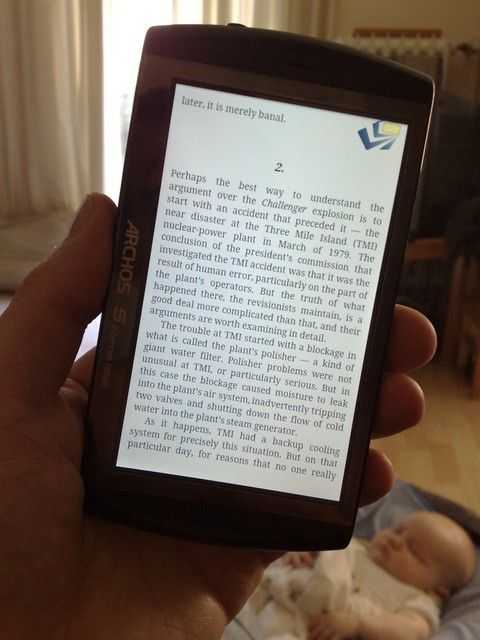
The results beat a previously tested set smartphones and other pocketable ‘Internet’ devices by an average 9 seconds per page. In terms of Internet browsing performance, it blows the N800/N810 out of the water and even the iPhone only averages 20 seconds per page over WiFi. [Aigo averages 12 seconds] The only pocketable device that gets close is the new Archos 5 with an average, over a similar set of tests, of 15 seconds.

It does pretty well on video playback too with higher-bitrate files really taking advantage of the high-quality screen. Its just a shame that the media software is so basic. In my opinion, Video, Search and Browsing are the most important elements of a MID’s capabilities so lets see how the Aigo P8860 performs. Videos and notes below…

Read the full story

dmedia G400 MID for early 2009

Tags: , , , ,


dmediaThe MID market is really starting to build up steam in and its fairing-up to be an exciting Q1 2009. Here’s the latest entrant under the ‘next-gen PMP’ banner as presented by Pocketables. With a possible ARM-11 core, this may not be the powerhouse required by many pro-mobile users and if the media experience isn’t up to scratch, it probably won’t compete well with the Archos 5G but it at least proves, again, that mobile devices are evolving towards a better mobile Internet experience.

Read what Pocketables have uncovered here.

The iPhone is the Apple netbook?

Tags: , , , ,


Many others have written about it. NYTimes. ARS Technica, Liliputing, GearLog are just a few. This taken direct the article at Small-Laptops.

Jobs on netbooks: “As we look at the netbook category, that’s a nascent category. As best as we can tell, there’s not a lot of them being sold. You know, one of our entrants into that category if you will is the iPhone, for browsing the Internet, and doing email and all the other things that a netbook lets you do. And being connected via the cellular network wherever you are, an iPhone is a pretty good solution for that, and it fits in your pocket.

I love that attitude. He’s effectively saying that MIDs are where it’s at isn’t he. Isn’t he? The ‘Not a lot being sold’ part is probably a nod towards their 7 million iPhone sales.

I agree with Jobs and believe the Netbooks segment is a dangerous segment to be playing in right now. I believe that the action will start to take place in other segments soon. It will only take one well-executed MID/PMP product to make heads turn and for people to realise that most of what they do on their netbooks (surfing, reading emails, IM, videos) can be done by a device that fits in the pocket. Yes I know some of you use netbooks as laptops for inputting text but to be honest, I don’t think that inputting reams of text is what most people are doing with their netbooks. When that special product comes out and when those heads turn, people like Samsung, Toshiba, ASUS could get caught out with big zero-margin netbook stocks. In fact the whole Intel Atom ecosystem could get caught out if that device turns out to be based on an ARM core and gets followed up by a raft of cool ARM-based devices from established players.

Jobs will need a product to replace the iPod in the next 18 months and a combined video and Internet device is perfect for that. There’s almost no question that Apple will do a 4-6" device and that the technology and software is there to be able to do it but the question is, when will the market and carriers be ready? End of 2009? Beginning of 2010? Apple must have tens of prototypes in the lab ready to choose from and they’re probably doing the sensible business thing by waiting.

Poulsbo. Big video on Little Devices.

Tags: , , , , ,


aigovid Back in April, I published my thoughts on how MIDs could raise the bar for high-end PMPs. I wrote the article after I saw some interesting notes on the video hardware that was going to be included in Poulsbo (now called the System Controller Hub, the chipset that accompanies Z-series Atom CPUs.) When I got the Kohjinsha SC3 a few weeks ago it was the first chance I’d had to test a Menlow based device (Atom Z-series + SCH) so one of the first things I did was to download a high-end WMV file and play it in media player. I also downloaded Quicktime and the Klite Pack to get some H.264 support. What I saw was less than impressive.

At the same time, Jenn at Pocketables.net was doing similar tests with her SC3 and to cut a long story short, between us and the feedback of forum members and readers, we’ve ended up in a position where we’ve only found one commercial software package that will enable just one of the built-in hardware decoding features. H.264 [See Jenns article about 1080p on The Willcom D4.] On one hand its a poor result and a major disappointment. There’s no single player available that can support playback of all HQ content and if your content is wrapped up in DRM (iTunes films for example) there’s no support at all. It all sounds like quite a sad story. On the other hand the H.264 part of the story is good (no, excellent - 15mbps H.264 anyone?) and it looks like there’s more to come if Poulsbo can be unlocked further with the right software.  (article continues…)
Read the full story

Archos advances.

Tags: , , , ,


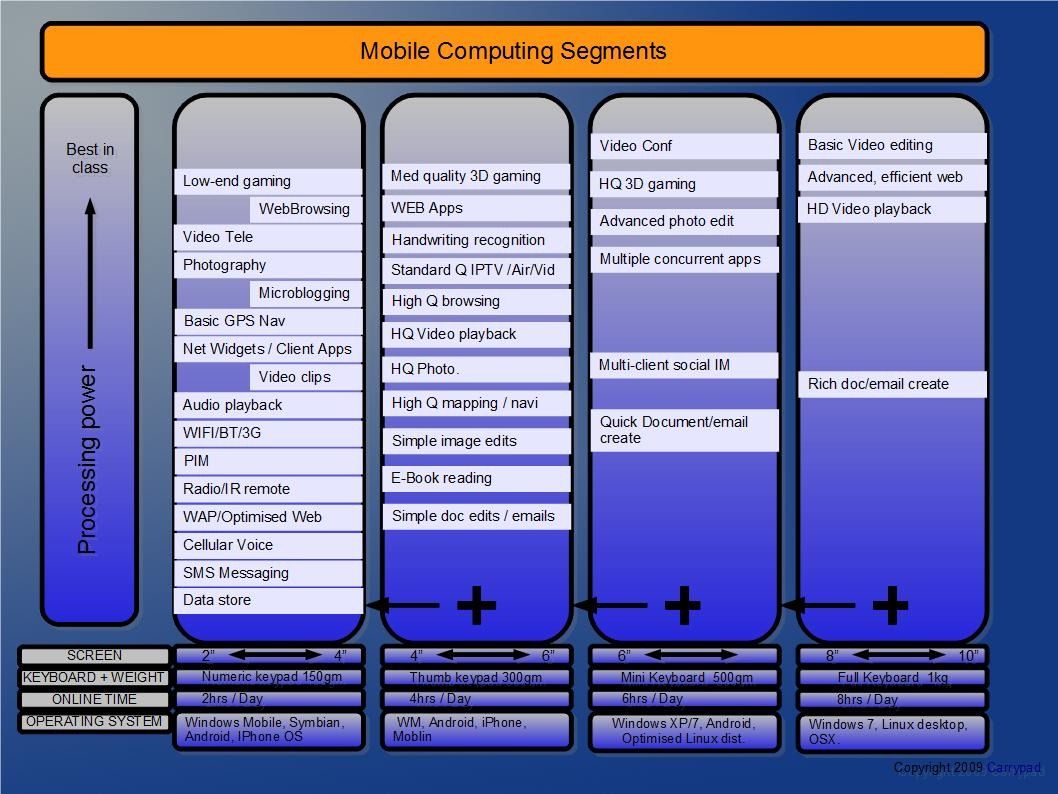
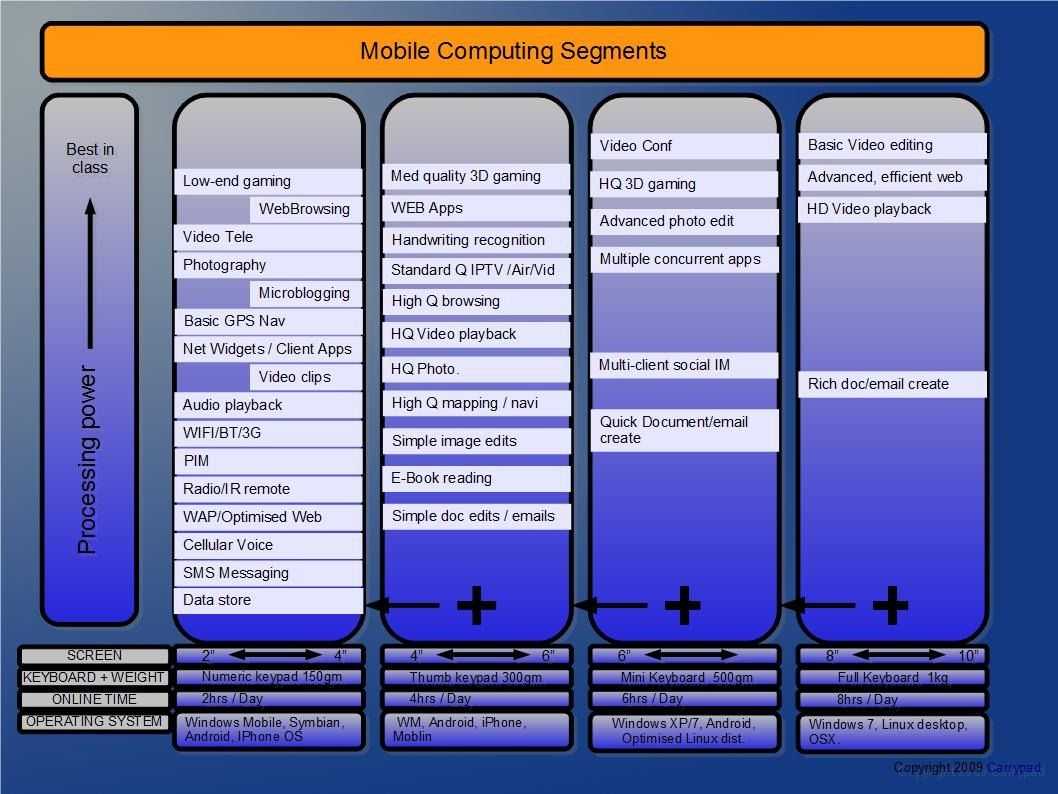
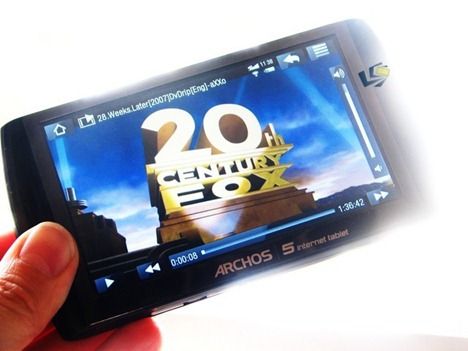
Archos are moving, very quickly this week it seems, to combine the three major, non-smartphone, consumer mobile activities onto a single device. Thats the high-end PMP function (that requires a 4-6″ screen size,) the mobile Internet (that requires a 4-6″ screen size) and Navigation (that requires a 4-6″ screen size.)

Archos

Now i’m not saying that you can’t do those functions on a smaller, or even bigger, device but these are the three areas I see that are absolutely ripe for dropping into a hand-held device where the quality of presentation and capability could be far greater than a smartphone could provide. It’s MID territory…

Read the full story