


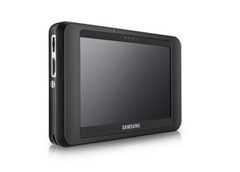
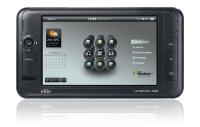
The Samsung Q1EX is due to head on to its next review appointment so it’s time for me to round-up my coverage of it by giving you some performance test results and an overview. It should at least give a reference point for future VIA Nano-based products and an idea of where this device fits in. It’s a difficult device to position but when compared with peer devices, it offers improvements all round at a good value price.
Overall performance levels as measured by CrystalMark are in the netbook class which is good for a UMPC. I saw CPU results coming in at what I’d normally expect from a 1.3Ghz Atom Z-series CPU but similar clock-for-clock results when compared to, say, the older Pentium-M. It’s nearly twice as powerful as the VIA C7 at the same clock speed according to the results. The summary is shown below and the details can be seen here.

In real-world usage I found the Q1EX to be powerful enough for most daily tasks. Browsing the web is as fast, if not faster than on most UMPCs but not quite up to the standard of a 1.6Ghz Atom-based device. One of the biggest issues on the Q1EX, and this has nothing to do with VIA, is the choice of a 4200 RPM 1.8 inch Samsung drive. As we’ve seen on so many UMPCs, MIDs and netbooks , there are good value SSD options now. The drive is the biggest bottleneck of the device with a very average 30MB/s read and write speed. By comparison, the 1.3Ghz Intel Atom-based UMID device we have here runs a much faster 50/50MB/s SSD and it feels way faster than the Samsung Q1EX.
Graphics results that we’re seeing on CrystalMark easily beat those found on the Intel netbook and MID platforms and could provide a clue as to where Samsung are aiming this device. Mobile Architects perhaps? Mobile Doctors? The high quality touchscreen that offers a level of palm resistance certainly back this idea up but without 3G though, it’s hard to imagine it being the perfect mobile tablet. Hospital use seems like a better fit where the Q1EX could beat the mini-tablet competition with it’s brand, build quality, performance and price.
The 3DMark2001 SE result was 1777. (Details here) The 3DMark03 result was 540. (Details below)


3DMark2001SE and 3DMark03 scores for the Samsung Q1EX.
The ultra mobile PC community have also used the Fritz Chess Benchmark in the past. The result of 549 Kilo Nodes per second sits right between the A110 (Stealey, 800Mhz) and the Celeron M at 900Mhz. Not the best ultra mobile PC for a quick game of chess. (For a list of CrystalMark and Fritz Chess Benchmark results for a number of UMPCs, see this reference list.)
Samsung Q1EX Unboxing and first impressions available here.
The relatively good CPU and GPU performance comes at a price. Under load the Q1EX platform power usage can jump from 7W idle to 15W or more. With the 1.2Ghz U2500CPU having a TDP of 6.8W and the VX800 chipset adding another 5W, it’s actually surprising that Samsung have managed to build it into such a small chassis without it getting too hot under load. I don’t expect to see anything much smaller than the Q1EX with a VIA Nano at 1.2Ghz inside. Samsung have, as always with their UMPCs, done a good engineering job.
For a UMPC, the Q1EX has turned in some respectable performance results. The CPU and 3D performance is, relative to other UMPCs, good. If only Samsung had gone for an SSD though it would have felt so much faster than it does. The battery life is worth considering too. Heavy-load battery life can drop to well under 2hrs. Idle battery life is over 4hours.
The Q1EX is clearly a very targeted product and as a well-built, stylish tablet, its better than similar tablet UMPCs. In that respect its very good value. For its target market its a well built product that offers relatively good levels of performance. Good marks go to the Q1EX’s minimalist styling and build quality, its light weight, the on-screen menu and scroll-wheel, the excellent quality screen and its graphics capabilities.
More Q1EX details, links and specifications can be found in our product pages. Many thanks to VIA Technologies for sending it over.


New article: Samsung Q1EX, Via Nano Tablet, Performance Tests and Round-Up. http://cli.gs/tyqQvR
Nice little summary, Chippy. Question: which is more usable – the Q1Ex, or the SC3?
They both do well as mini tablets. SC3 is bigger, heavier, but has a nice battery section to use as a grip and, of course, has the keyboard. It suffers from same problem as Q1EX, namely slow HDD.
It really depends on how you want to use the device. You have to go deep into your requirements and match up against the two devices.
Steve
so its slower than the best Atom .. has a 3x higher TDP than Atom .. costs more than Atom
am i missing something or why in the world would anybody recommend this CPU when compared to the Atom?
Wouldn’t it make more sense to compare the best Nano to the best Atom? Or to compare Nanos and Atoms of roughly equivalent TDP? Either one would be more fair than comparing a mid-model Nano to the best Atom. (i.e., “slower than the best Atom” may be a true statement, but, unqualified, it’s not a very meaningful one.)
In any case, what I got out of Chippy’s review is that fast persistent storage may be more important than CPU in the user impression of how fast a system feels. (Obviously, this may go out the window if you do something truly computationally intensive. How often does that happen on a handheld device though?)
Maybe for its x64 architecture and 1MB L2 cache?
Any chance you’ll get to try Mer (the open version of Maemo) on it while you’ve still got it? While I’m still dubious about the changes they’ve made since the Q1 Ultra, I wonder if it might actually be usable as a Mer platform.
I’m also curious if Ubuntu 9.04, with Netbook Remix, will work on it.
Sorry John, It really was heading on to the next reviewer and is now packed up and waiting for Fedex.
Found: Q1EX Performance round-up http://tinyurl.com/pvzsk6