Back in Feb, I listed a set of devices that should be high on your list if you’re thinking about mobile microblogging. It included MIDs and UMPCs. As the market for mobile social networking, mobile web search, mobile content creation, location based services and lifestreaming (my rough definition of Mobile Microblogging) gathers steam we’re seeing more and more devices coming into the segment and it’s mainly from the smartphone sector. UMPCs and MIDs aren’t getting a look-in. In fact, in my latest list, below, you won’t find a MID or UMPC.
Smartphones with bigger, higher resolution screens and high-end processors are appearing on the radar almost every week. Smartphone-based mobile software development is increasing too as more and more mobile device application stores tempt developers with easy-to-use, rich SDKs and APIs, a channel that reaches right down to millions of users devices and a good cut of any earnings.
What’s really interesting about the Mobile Microblogging phenomenon is that very little software development is happening for today’s Intel MIDs, the very devices that were targeted into this segment. Intel have stopped work on the Moblin OS for them and they’re effectively UMPCs. You could even argue that there are no Intel MIDs any more! They are being totally left behind in both software and hardware until Intel push the reset button when Moorestown MIDs with Moblin hit the market. Until then, it’s desktop operating systems for MIDs and UMPCs.
You won’t find an easy-to-use, small-screen, GPS-enabled search service on Windows. You can’t even link Google Maps to a GPS on the browser. Forget the thought of a compass helping with augmented reality, an accelerometer, an FM receiver with RDS or, if you’re into internet photography, a half-decent snapshot camera. There’s no application store either. Only on smartphones will you find the creative software and hardware that is driving the mobile microblogging market and making it exciting, fresh, competitive and, quite frankly, desirable.
Moblin-based MIDs do have a chance as do Maemo 5 based devices but you won’t find any on the market yet so it’s going to take time for the developers to warm to those platforms. Come back in 2010 to discuss that!
Apple and Android have done a lot for the new generation of mobile internet devices and usage scenarios and so it should be no surprise to see smartphones dominating this Mobile Microblogging segment to the point where UMPCs and MIDs don’t get a look-in. UMPCs and Netbooks still have big advantages for general purpose, day-to-day productive computing but if mobile creativity is your thing, there’s nothing better than the new generation of smartphones.
One could argue that smartphones have grown into the MID segment but for me it was always about usage scenarios rather than device categories. As Intel said, communication, location, entertainment and productivity. It’s a shame that Intel’s MIDs aren’t living up to their own hype yet. (see my recent Moorestown article for thoughts about 2010)
Don’t get too excited at this stage. No products. No software. But at UMPCPortal we’re excited to see these two huge mobile computing and communication companies work together on a mobile computing project that will create the next generation of mobile computing products.
Key elements of this ‘technology’ announcement:
Nokia and Intel want to co-develop a new class of Intel Architecture based mobile computing devices.
Collaboration in Open Source projects. (Maemo and Moblin)
Intel acquire Nokia HSPA device license.
“Leader in computing. Leader in mobile communications” coming together.
Note that this announcement has nothing to do with WiMax or Symbian or any part of the existing ARM relationships.
From the Press Release…
SANTA CLARA, CALIF., and ESPOO, FINLAND, June 23, 2009 –
Further uniting the Internet with mobile phones and computers, Intel Corporation and Nokia today announced a long-term relationship to develop a new class of Intel® Architecture-based mobile computing device and chipset architectures which will combine the performance of powerful computers with high-bandwidth mobile broadband communications and ubiquitous Internet connectivity.
For the end-customer, somewhat boring but clearly a significant boost to Intel’s Ultra Mobile ecosystem and something that will have significant impact on devices in 2010, 2011 and beyond. In terms of software, if Nokia move to Intel architecture then they will have to shift Maemo over to a Moblin core. Expect Maemo to branch into two within the next few years. This is all about high-end smartphones, social networking, video and back-end systems.
Already in my calendar yesterday was a short-notice conference call from Intel. Apparently they have an announcement to make. This morning I woke to see the keywords Intel and Nokia streaming through twitter and google reader. The rumor is that Nokia will be using Intel inside.
I assume this is a Moorestown product win which means it sits alongside the LG announcement for a 2010 product launch If this is true, it’s a really significant step forward for Intel in the Ultra Mobile and smartphone market.
Questions to be asked:
Is it going to be voice enabled?
What operating system (Moblin, Maemo or Symbian)
Are Nokia simply testing the market and technology (in which case i’d expect it to be in a next-gen Nokia tablet rather than a phone)
If it’s a tablet, does it mean that the OMAP3-based tablet is scrapped?
The rumor comes from Bloomberg. The press call is at 1130am EST. Expect news on UMPCPortal as at breaks.
Jkk has tons of video coverage of the now finished Computex 2009. Here he has an interesting 17 minute video of a Q&A with Intel’s General Manager of the Ultra Mobility Group, Anand Chandrasekher. Jkk also rounded up a list of all the people in attendance, as follows:
An interesting watch if you want to understand how Intel is handling the upcoming Moorestown platform and have a chance to see and hear from some prominent members of our blogging community.
I wrote an update on Moorestown last week over at MIDMoves.com but I want to expand on that here on UMPCPortal today because I really think that the new information we have now is extremely significant for the core audience here. Moorestown is the first computing platform that covers my definition of ultra mobile computing. From high-end smartphones, through targeted, Ultra Mobile ‘desktops’ , super-mobile laptops and the whole range of internet-connected opportunities that exist in the mobile internet space.
I’ve been careful to point out in the past that Moorestown and Menlow will overlap and continue to be available as two separate platforms in the MID space. While a version of Moorestown will support XP, it won’t be the version that we’re seeing touted for smartphones. Even Intel were careful to point out that you won’t see the same power envelope with Microsoft products so clearly, Moorestown is initiall a cut-down or special ‘crafted’ platform that only works with Moblin.
Menlow is that platform that continues to be offered for use in UMPCs and note here that Intel appear to accept now that Moblin V1 isn’t going to be the primary OS for Menlow based systems. I think it’s fair to say that Menlow and Moblin V1 failed and even distracted the market for ultra mobile solutions until it got back on course recently with XP versions of the original MIDs. I’m even hearing and seeing Windows 7 being promoted for UMPCs and if OEMs can keep the licensing costs low and ssd speeds high, it will make a great solution.
So that brings us to the Compal KAX-15, the only Menlow-based device that was announced within the Intel meetings. It was shown in the Ultra Mobility keynote and JKK got straight over to the demo device and gave us the full details in a video. (below) Before that, the specs.
It has a sliding/tilting keyboard that is similar to the HTC Shift but on a smaller scale. It’s a bit bigger than the original Compal MID that Aigo and Gigabyte used but that is probably due to a bigger battery. Compal will be aware that the battery life on their JAX-10/KAX-10 is no longer competitive in the UMPC space.
Screen size: 4.8”, 800×480
CPU: Z515 with 800Mhz and 1.2Ghz bursting. (Which I think means that designers can build around the TDP of the 800Mhz part but i’m not 100% sure. Sounds just like speed stepping to me)
No mouse controller
Dual web cams
I think it’s fair to say that this is in the running to be the next Aigo MID. Personally I find it a better form factor than the UMID M1 but we’ll have to see about battery life.
We’re not quite sure if we’re supposed to have this PDF but it’s just landed in our lap and we don’t see any confidential markings so we might as well relay the info. It’s a slide set from an investor meeting from the Ultra Mobility group and it highlights a few interesting points about Moorestown and Medfield. It appears to be dated 05_2009 so it’s very recent.
Intel now regard Moblin as a ‘core competency’ (which is significant considering they don’t run it any more!) and consider themselves the 2nd biggest contributor to Linux on the planet. So reports FT today which is in itself significant and shows just how far the Moblin keyword has penetrated.
According to FT, Moblin are just about ready to ship 2.0 Beta which, if it follows the Alpha releases, will target netbook platforms and not Intel’s Menlow platform. The MIDs will be included in a 2010 release which is a shame because with a claimed 7-second startup time, some tempting reports coming in from twitter and the nice image below, is something I really wouldn’t mind seeing on the Viliv S5, UMID or Aigo MIDs.
I’m very reluctant to be talking about Medfield. It’s the codename for the system-on-chip that Intel are working on for 2011. That’s the next step after Moorestown which is still at least half a year away. We’re still waiting for a bunch of promised Menlow-based devices a year after launch and two years after its first mention here on UMPCPortal so I’m not getting excited.
Moorestown is planned for early 2010 and will push Intel further into the MID category and enable voice-enabled, large-format smartphones. LG have already made an announcement along these lines. The marketing people will tell you about 10x lower platform idle power which works well for standby communicators but means nothing for devices you’re actually using. Menlow brought us swiftly down from the 10W power profile to the 6W power profile so I think it’s fair to say that we’ll be looking at devices operating in a 4W power profile with Moorestown.
The next step for Intel is into small-format smartphones. Phones like the iPhone and the Pre. CNN are giving us a tiny lead into Medfield today with an article that reveals the codename ‘Medfield’ and talks about a single chip design. But there’s not much more detail there at all so that’s all we’re left with. You can try reading between the lines at CNN.com but I’d recommend staying focused on Moorestown first. Computex is in just over 2 weeks so there’s lots of excitement to come before we start getting into the details of Medfield.
JKK has edited up the keynote video from IDF Beijing that took place a few days ago. In the video you can see a number of the MIDs that were announced in one of the press release. [PDF]
Click through to JKK’s site for some more images. The BYD clamshell phone (based on Menlow) is particularly interesting. Obviously we’ll try to get more detailed information on these but at the moment it’s looking like an Asia-focused effort. We may have to wait until IDF in Sept for an sort of hands-on. jkkmobile: Intel shows new MIDs at IDF Beijing 2009.
As I was reviewing my keyword searches on the social network Twitter this morning (I use Particls.com) I came across a really interesting question. @phabulosa asks: “Really want to know why Moblin can boot that fast and how instant-on Linux works. Someone can tell me?”
We haven’t actually brought you the good news that Moblin 2, Alpha 2 has been released yet so before I dive into the above question, let me give you a brief update on changes over the Alpha 1 release.
SlashGear is reporting that Intel is working on a version of something called an SIMD accelerator that will help increase graphical performance on future mobile devices. There isn’t too much to go on with the small amount of information that Intel released, but apparently the SIMD (Single Instruction, Multiple Data) accelerator that they are working on uses 10x less power than current SIMD accelerators use, making the new SIMD accelerator practical for use in handheld devices, particularly MIDs, as Intel mentions.
The concept of Single Instruction, Multiple Data seems somewhat contradictory to the current Atom processors which use in-order execution, but then again, I can’t claim to be an expert on CPU architecture, so these things may be unrelated. It sounds like Intel’s newer, less power hungry SIMD accelerator could be used in conjunction with their upcoming Moorestown platform.
As time draws closer and closer to the time when Intel’s Moorestown platform is due to be released, I’ve been looking around at some of the concepts that they have been showing over the last year to get an idea of what we’ll see when the Moorestown platform hits. Moorestown is a platform for an upcoming set of devices that will blur the lines between smartphones and MIDs. Chippy used the term ‘MIDphone’ not long ago in an article about a voice capable software stack that would be making its way to Moblin (a MID oriented OS). One of these MIDphones that you will probably recognize is, at this point, nameless, but many have said that it looks to be a super-wide iPhone (let’s call it Moorestown X). A little while back, Intel released three videos showing concepts of what they want a device like Moorestown X to be able to achieve with the platform:
Moorestown vision part 1
Moorestown vision part 2
Mooretown vision part 3
As I look at these videos and compare similar hardware that we have access to today, I get quite excited to see if something like this can be delivered. Obviously the videos above are simply conceptual, but if they could deliver functional software that is even half as polished as what we see above, it would make for an excellent device, as long as the Moorestown platform is really up to the task of delivering this experience with the battery life that people expect from a phone. Moorestown is purportedly going to consume ten times less power while idle than current Atom platforms. Concepts like these always make the software look good, but I hope they spend some serious time on the GUI if they are planning on bringing a similar product to market. I can’t stand the idea that the eye-candy would get in the way of productivity.
It seems like some of the focus on Moorestown has been shifted in light of the success that Intel has been having with their Atom platform, which powers an incredible amount of the netbooks that we see today. As far as we know however, Intel is still hard at work on Moorestown, and as soon as they complete their work, which should be in late 2009 or early 2010, we’ll start seeing hardware that should change the way we think about pocketable computing.
It is interesting to me to think about what will happen to devices like the iPhone and upcoming Palm Pre when they are put in perspective with the kind of devices that we could see coming from Moorestown. Competition always functions as a driver for innovation, so I think its safe to say that the release of the Moorestown platform will be good for everyone in the long run.
Thoughts on the Moorestown vision? What would you be willing to pay for a device like the Moorestown X? Are you excited about the upcoming platform if it could bring products like this into the smartphone/MID space?
I enjoyed this article at APCMag. There’s a lot you can read between the lines and a lot of straight-up info.
Intel are now calling smartphones, MIDs
There’s a definite netbook roadmap
It will take 3-5 years to seed MIDs on Intel
Some netbooks may appear on the Moorestown platform
Favorite quote:
“Every smartphone is a mobile Internet device, including the iPhone” says Pankaj Kedia, director of ecosystems for Intel’s Ultra-Mobile Group. “If the device is mobile, if it delivers a rich internet experience and has a targeted usage, it’s a mobile Internet device”.
You’ll also see some talk about power consumption. 10x less idle power takes a Moorestown MID down to about 200mw. I assume that’s with screen off and radios sleeping though. It’s enough to get Intel into the high-end all-day smartphone market but not quite into consumer pockets just yet. That would take another iteration of Atom and a 2011/2012 timeframe in my opinion.
So smartphones are the new MIDs. Or should MIDs be the new smartphones? Have a read of the article and let me know your thoughts.
Back in October of last year there was some interesting news about a site (WePC.com), made in conjunction with Intel and Asus, that would allow users to submit concepts of their ‘dream computer’ and have it voted on by a large community. The idea was that the best concepts would float to the top and Asus would take these and build a community designed netbook, while Intel would power it.
I took another look at the site today to see if we had made any progress, but from what I’ve found, it seems like we won’t actually see a community designed computer in its own right. I can’t say if this has changed since the initial launch of the website, but the About page seems to set a slightly different tone than the rest of the site.
Imagine your perfect PC. Now imagine top engineers and innovators working around the clock to make that Dream PC a reality. That’s the dream WePC.com is all about.
ASUS and Intel have created WePC.com, a place where users like you come together to share ideas, images and inspiration about your ideal PC. But what if it’s not just talk. Your designs, feature ideas and community feedback will be evaluated by ASUS and could influence the blueprint for an actual notebook PC built by ASUS with Intel inside.
If the words ‘could influence’ weren’t already unlikely sounding enough, you have to consider that they are only talking about a ‘blueprint’ here. While it definitely sounded like WePC was actually going to produce a community designed netbook based on the best ideas, it seems now like the site is just a glorified feedback center for Asus, and a free source of concepts for them as well. There isn’t a lack of advertising either, with one part of the site saying “Buy a dream PC now!” that links to an already existing Eee PC. Wasn’t the point of the site to design our own dream PC? Is it crazy of me to still wish we would actually see a community designed computer that one could purchase come from this project?
As CPU and chipset power consumption becomes less and less in phone and MID designs, the power drains of the displays, radio, peripherals and storage technology become more and more significant. One of the biggest issues, display backlighting, has been something that many people have been working on for a long time. In current high-brightness UMPCs and MIDs the screens can take up to 50% of the total power of the devices, which is exactly the scenario you’re in when you’re mobile.
LG will be tackling this issue on their Moorestown phone in 2010 by using a reflective, bi-stable technology from Mirasol Displays, a subsiduary of Qualcomm. It’s complex and vastly different from current backlit screen technologies but I can summarise by saying that it takes a lot less power, provides much more effective outdoor brightness and, due to it’s transflective nature, is easier on the eye. The method used is known as Interferometric MODulation (IMOD.)
Mirasol IMOD Structure
There are some white papers and overviews on the Mirasol website which I have been through to try and get a feel for the power savings and although there aren’t any real figures given (obviously it depends on the size of the display) my gut feeling here is that in 3-5″ devices in bright room conditions, it could save 0.5 - 1W which will be extremely significant in the LG device which may only have a 2-3W profile. If you want to get a feel for the technology, take a look at this PDF which alludes to newspaper reading quality in terms of contrast and reflectivity. There’s also a very good video presentation here which the problems of traditional backlit displays and the ‘on-time’ that I’ve been highlighting recently.
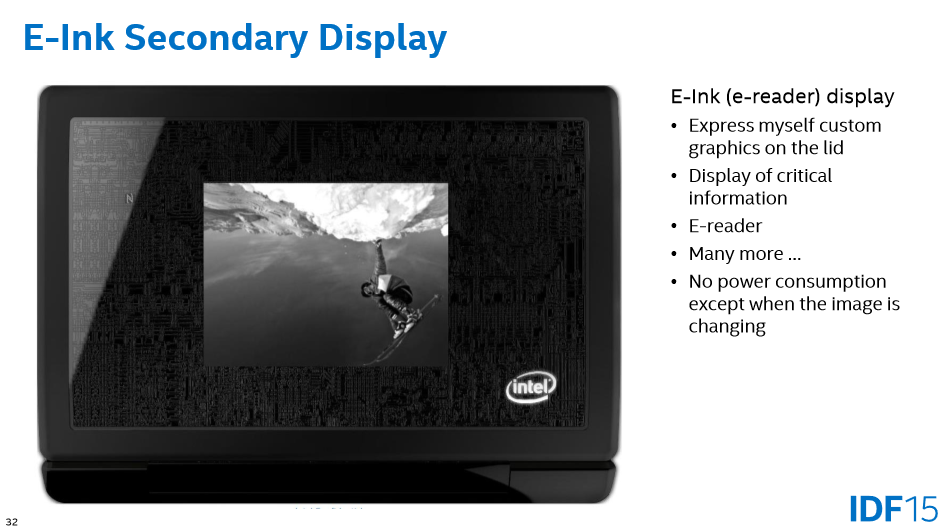
It appears that current Mirasol products are currently quite small in size and obviously the technology is going to be more expensive so we might see this used as a secondary or external display (as in the two screen Nokia E90 design) but with 12-18 months to go before the product needs to be ready, Mirasol may be able to get a full 800×480 screen out.
Highlighting Intel’s ultimate goal for Atom, the growing importance of a high-speed web experience on a smartphone and possibly Intel’s concern about the speed of development of ARM-based smartphones is this Mobile World Congress announcement that LG and Intel are going to work together on a voice-enabled MID. The first smartphone to be based on what is effectively a PC architecture is expected in 2010.
No details of the device are available at the moment but you can be sure that LG will already have prototype designs built around the Atom core (on the Lincroft ’system on chip’) and the Langwell I/O hub. Expect a high-end, big-screen design that, like the recently announced Toshibe LG01, could redefine the size and capability of those leading edge voice communicators called smartphones!
The announcement also re-confirms timescales for Moorestown and Moblin2 for MIDs and LG is expected to be one of the first OEMs out of the door with Moorestown in 2010.